
How to Hire Offshore Python Developers: Costs, Benefits & Best Practices [2026]

![How to Hire Offshore Python Developers: Costs, Benefits & Best Practices [2026]](https://ncube.com/wp-content/uploads/2026/09/Web-development-offshore-1.png "How to Hire Offshore Python Developers: Costs, Benefits & Best Practices [2026]")
Key takeaways:
Companies that hire offshore Python developers usually save 40%-60% on engineering costs compared to US and UK rates. In those countries, senior Python developers often earn $140,000 to $185,000 or more each year.
Most offshore Python developers are found in two regions. Eastern Europe is known for strong AI, data, and backend skills. South and Southeast Asia have the lowest rates and the largest talent pools.
Offshore and outsourcing are not the same thing. Offshore refers to where your engineers are located, while outsourcing means giving project delivery to another company. With nCube, you can hire offshore engineers who report to your team leads and work directly in your codebase.
There are five ways to engage talent. Freelancers are best for one-off tasks or projects with clear deliverables. Staff augmentation helps fill specific skill gaps. A dedicated team works well for products that rely on Python over the long term. An offshore R&D center lets you build your own permanent engineering team.
The main risk is a gap in quality, not cost. To avoid this, review code from your own repository, have an architecture discussion, and offer a paid two-week trial.
Adequate onboarding is key to success. Make sure you set overlap hours, provide a working development environment on the first day, and assign a mentor. These steps are often more important than the hire itself.
Ask a CTO what makes hiring a senior Python developer difficult today, and the answer usually isn’t a lack of applicants.
The challenge is that general Python experience is no longer enough for many teams. What they need is engineers who combine strong Python expertise with production experience and, increasingly, AI, data, or cloud skills.
That combination is both harder and more expensive to find. Senior Python talent in the US can command $140K–$185K+ per year, while specialized skills can push compensation even higher.
That’s why teams at every stage now hire offshore Python developers. Not as a budget hack, but as a deliberate way to reach engineers with that profile and keep the roadmap moving.
This guide walks through offshore Python development costs, engagement models, where candidate evaluation often falls short, and what changes once the right hiring process is in place.
What is offshore Python development?
Offshore Python development means engaging Python engineers based in another country, usually one with a large pool of skilled developers and lower hiring costs.
The terminology around these approaches can be confusing. Offshoring, in fact, is not the same as outsourcing. Outsourcing means handing a defined project to a vendor who owns delivery, whereas offshoring describes where the engineers are based.
You can do either: assign a scoped project to an offshore software development provider (that’s outsourcing) or bring in engineers who work under your management as part of your own team (as in offshoring).
Python fits either model. As one of the most popular programming languages worldwide, it has a broad network of offshore experts in backend development, data engineering, AI and machine learning, automation, and DevOps.
“Offshore” usually means a team several time zones away, often 5 to 10 hours from your main office. But offshore Python developers are not always a separate unit that receives tasks and returns finished work. They are deeply embedded in the client’s teams, processes, and culture. Even with only a few overlapping hours, they join the same sprints, use the same repositories, and follow the same review and delivery standards.
If you’re looking for a model with closer time-zone alignment, consider nearshoring: for US companies, it’s usually LATAM: Brazil, Argentina, Colombia, Mexico. Offshore Python programmers give you fewer overlapping hours but access to a much broader global talent pool.
What tasks can offshore Python developers handle?
Python is used for far more than web applications. Offshore Python development covers backend systems, data pipelines, ML models, automation, and cloud infrastructure.
In the US, the hard part is no longer finding someone who knows Python. It is finding engineers who combine Python with production experience in AI, data, cloud, or backend systems. According to Robert Half, 63% of tech leaders say hiring people with AI and data science skills is a major challenge for their projects.
Hiring offshore opens up a wider talent pool in markets where competition for those skills may be lower. Here are some of the areas where that talent can make the biggest difference:
- Web and backend development
Offshore backend engineers build REST or GraphQL APIs, optimize database queries in PostgreSQL or MySQL, and set up background tasks with tools like Celery and Redis.
They also help break down large, complex applications into smaller, more manageable Dockerized microservices using frameworks such as Django, Flask, or FastAPI.
- Data engineering and ETL
Offshore Python programmers set up data pipelines with Airflow or Prefect, clean and transform data using Pandas or PySpark, and load it into Snowflake, Redshift, or BigQuery. This gives your analytics and product teams access to clean, up-to-date data.
- AI and machine learning
Offshore Python teams support the full AI lifecycle, from early prototypes to production. For example, a team of six engineers at nCube built video and audio recognition features for Veritone using Python, Flask, and Docker.
See how Veritone scaled with Python engineers.
- Automation and scripting
Using PyTest, Playwright, Pandas, and OpenPyXL, offshore engineers automate repetitive engineering tasks and integrate these processes directly into CI/CD pipelines.
- Cloud and DevOps
As the product grows, the infrastructure behind it has to keep up. Offshore engineers define infrastructure as code with Pulumi’s Python SDK, automate AWS, GCP, or Azure environments using cloud SDKs, containerize services with Docker, and monitor cloud costs to prevent overruns.
- API development and integrations
Offshore Python teams help connect the systems your product relies on, like payments with Stripe or Braintree, syncing data with Salesforce or HubSpot, handling webhooks, building custom API wrappers, and setting up secure logins with Auth0 or Okta.
Benefits and challenges of hiring offshore Python developers
Teams that hire offshore Python developers solve the problem we highlighted earlier: limited access to specialized Python talent in North American and EU markets.
On the other hand, this approach also creates challenges around communication, quality control, onboarding, and IP protection if your company isn’t prepared for them.
| Benefits | Challenges |
| 40–60% lower hiring costs | Fewer shared working hours |
| Larger pool, faster access to niche skills | Familiar hiring signals don’t apply |
| Easier team scaling | More onboarding and knowledge transfer |
| Potential for follow-the-sun delivery | Different working and feedback norms |
| Less competition per senior candidate | IP and security need clear safeguards |
#1. Access specialists without US-level hiring pressure
The biggest advantage is access to a broader talent pool. Rather than competing locally for rare skills like production ML experience with PyTorch and LangChain, companies can add offshore Python developers from multiple engineering markets on a global scale.
#2. Manage the quality gap proactively
A strong Python resume does not always show real production skills. A candidate might know the language but have little practice with things like asynchronous performance, database indexing, distributed systems, or secure API design.
Time zones, work habits, and onboarding can also cause problems. If there is not enough overlap, a blocked pull request can take 12 to 24 hours to get feedback.
Teams with different ways of raising issues might wait on a problem instead of bringing it up early. Poor documentation can leave new engineers unsure about the codebase.
#3. Vet candidates based on what they’ve built
What someone has built is more important than where they worked. Do practical code reviews and discuss architecture decisions from your own stack, such as how they would handle your scaling needs, data volume, or latency requirements. Pay attention to the trade-offs they made, problems they solved, and systems they delivered to production.
Also, have a senior engineer assess the candidate’s technical skills, communication, and teamwork. A paid two-week trial can also show more than interviews alone. At nCube, every candidate goes through a live technical interview with our engineering leads before they reach your shortlist, helping us maintain a 94% client satisfaction rating on Clutch.
#4. Structure the engagement for smooth delivery
Arrange overlapping hours in advance, and ensure new engineers have a fully working development environment and a mentor assigned during their first weeks. The success of offshore Python development largely depends on how well the team is integrated.
Considering an offshore Python team?
Tell us what you’re building and the skills you need. nCube can match you with vetted Python developers in as little as 48 hours.
Offshore Python development: Engagement models compared
A simple automation script obviously needs a different approach than an AI platform you plan to build over several years.
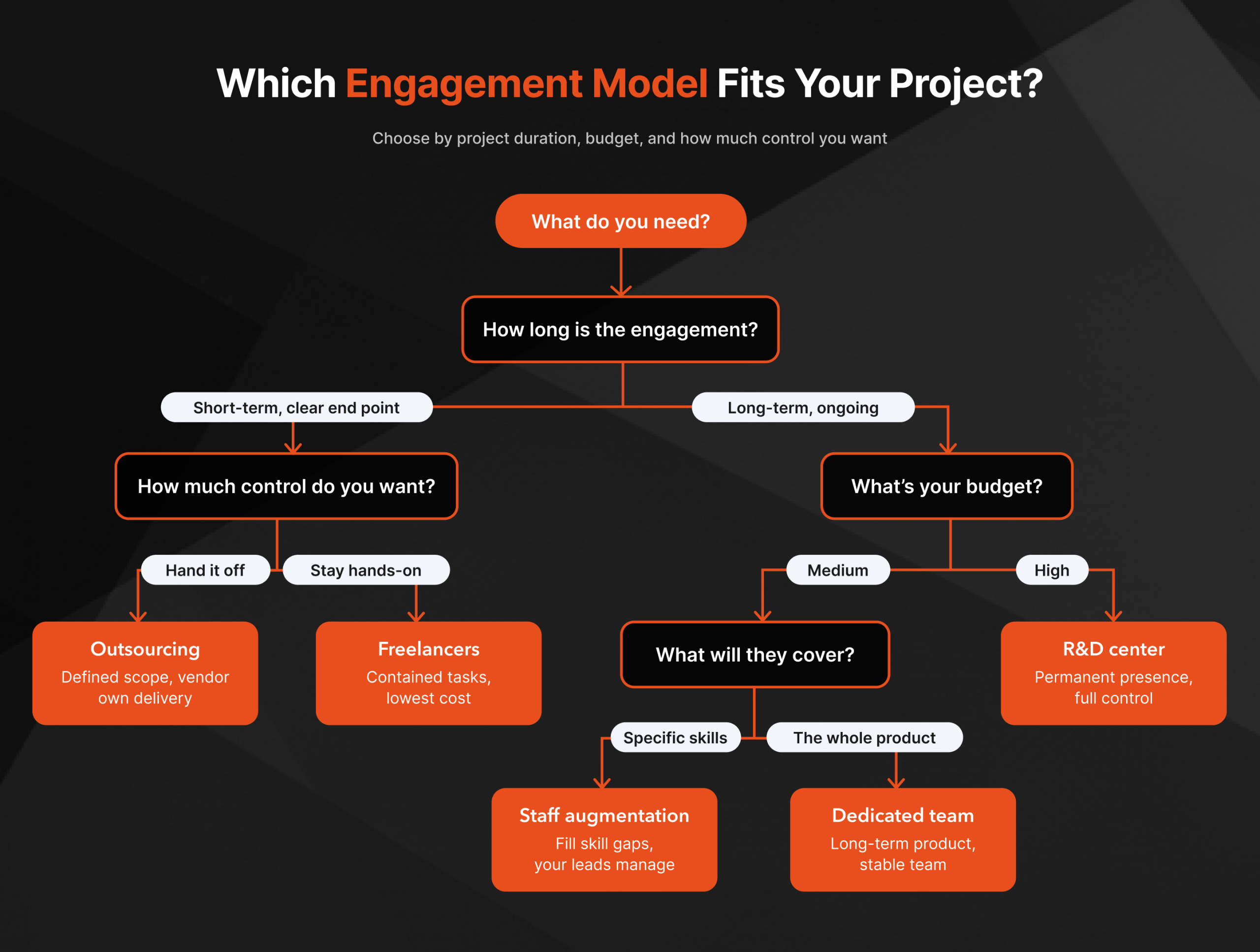
If you’re scaling, you need more continuity and ownership. The main difference between engagement models is who is responsible for delivery and how long the team works with your product.
An offshore Python development service can be structured in five ways, and each one shifts that balance differently.
| Freelancers | Outsourcing | Staff Augmentation | Dedicated Team | R&D Center | |
| Control | High | Low | High | High | Full |
| Cost | Low | Project-based/Fixed | Medium | Medium-High | High |
| Scalability | Limited | By project | High/Flexible | High | High |
| IP risk | High | High | Low | Low | Low |
| Best for | Short tasks | Defined work scope | Skill gaps | Long-term projects, ongoing development | Permanent offshore presence |
| Time to start | 1-2 weeks | 2-4 weeks | 1-3 weeks | 3-6 weeks | 3-6 months |
Use freelancers for contained tasks
Freelancers are a good choice when the job has a clear end point, like building a scraper, setting up automated reports, adding rate limits to an API, or handling a short migration. You stay in control, but also take on the extra work of finding and managing the freelancer.
Outsource clearly defined deliverables
Outsourcing is a good option when you know what you want to build but do not want to manage the engineers yourself. An offshore Python development company takes care of delivery for you end-to-end, which works well for projects like a data pipeline, an MVP, an integration, or a migration. The downside is that you have less visibility than with other models. You see the final result, but not the daily technical decisions.
Augment your team with missing skills
As a common offshore Python development service, staff augmentation helps close skill gaps in your current team without changing how you manage delivery. The added engineers work in your codebase, join your meetings, and report to your team leads.
This model is useful when your architecture is already solid, but you need more expertise in areas like FastAPI, PySpark, or MLOps without hiring full-time staff locally.
Build a dedicated team for long-term ownership
As your product becomes more complex, keeping knowledge under one roof becomes more important.
A dedicated offshore Python development team focuses on your product, learns your domain and codebase, and can grow as your plans expand.
Dedicated Development Team works best when Python is central to your product, and you want to avoid delays from bringing new people up to speed.
Set up an R&D center for a permanent offshore presence
An offshore R&D center is at the far end of the same spectrum. Instead of joining another company’s team, you set up your own permanent engineering site. This means you have your own company, your own hiring process, and a dedicated long-term team.
It is best for companies that want to build lasting capability, like a Python platform team that will continue beyond any single project. However, this is a big commitment. You will need to set up the entity, handle local employment, and have leadership on site, so it only makes sense if you plan for the long term.
How much do offshore Python developers cost? Regional breakdown
The cost to hire an offshore Python engineer depends a lot on the region. However, it’s not the only factor. Seniority, specialization, domain experience, and engagement type also play a big role.
| Region | Mid-level | Senior | Notes |
| United States | $95K–$130K | $140K–$185K+ | Highest rates of any market |
| Western Europe | $70K–$100K | $100K–$140K | UK, Germany, Netherlands |
| Eastern Europe | $35K–$55K | $55K–$85K | Ukraine, Poland, Romania — strong Python ecosystem |
| Latin America | $30K–$50K | $50K–$75K | Optimal overlapping hours with US teams |
| South/Southeast Asia | $18K–$30K | $30K–$50K | India, Vietnam, Philippines |
These numbers show the yearly salaries for full-time engineers, using data from Glassdoor and ZipRecruiter (US), 2026 Python salary benchmarks for Eastern Europe and LATAM, and nCube’s placement data from September 2026. They do not include contractor billing rates, which are figured out differently and usually lead to higher hourly costs. Mixing up bill rates and salaries is a frequent mistake in these types of analyses. For a broader comparison beyond Python, see our guide to offshore development rates by country, including pricing across major engineering markets.
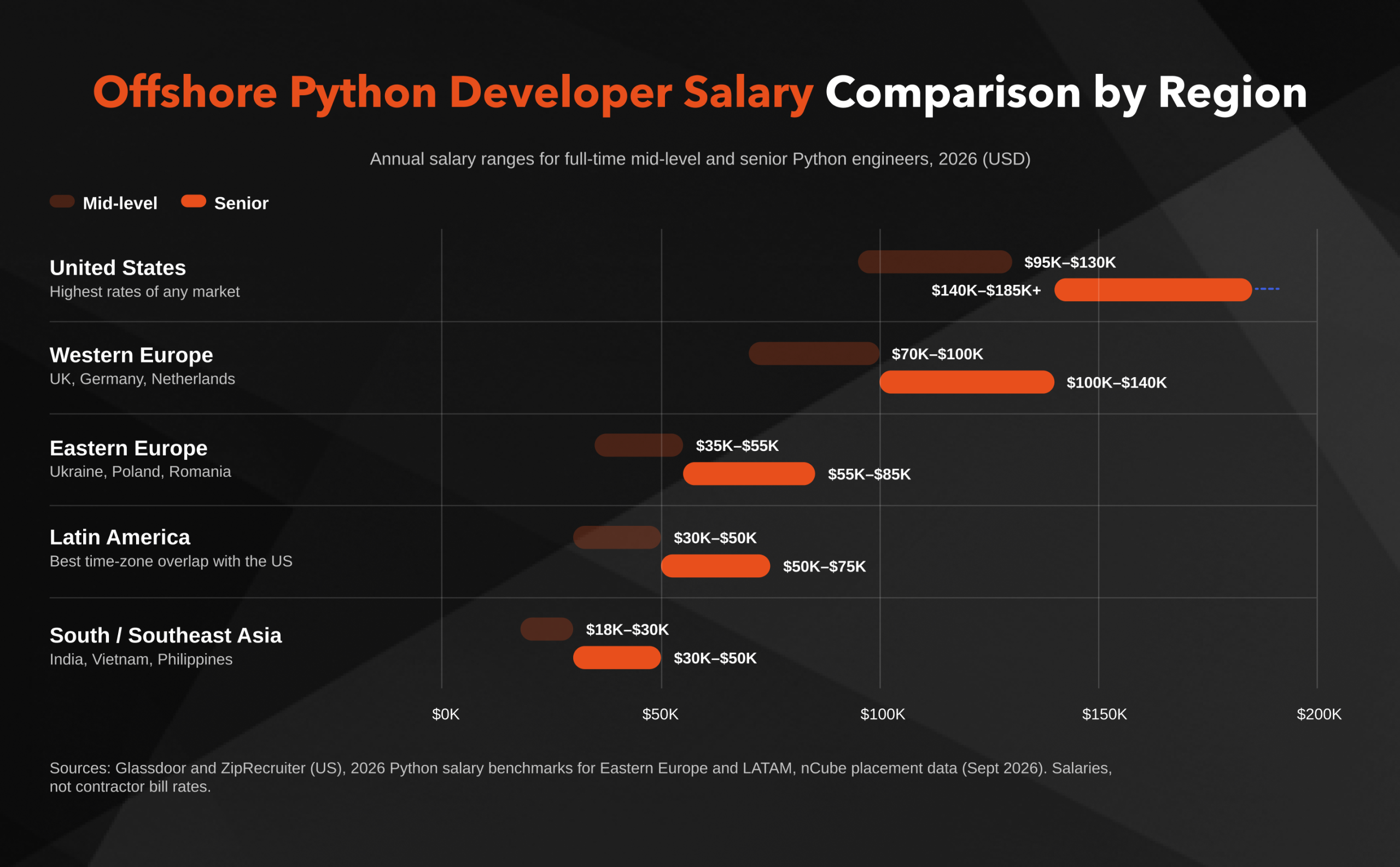
With a budget of $55K to $85K, you can hire offshore Python engineer talent with real production experience in Eastern Europe. That same budget gets you a mid-level engineer in Western Europe, but it is not enough for even a junior engineer in the US.
Seniority is the main factor that affects pay. Glassdoor reports that senior Python developers in the US earn an average of about $147K, with most salaries ranging from $113K to $193K. Because the range is so wide, the job title by itself does not reveal much. For example, a mid-level developer who maintains Django services earns less than a senior engineer who designs distributed systems or leads an ML platform. Roles that involve more responsibility for architecture and production tend to pay at the higher end of the scale.
Specialized Python stacks are more expensive. For example, using PyTorch with distributed training or LangChain with production ML infrastructure costs more because you need more than just language skills.
These roles require offshore Python programmers who can make architecture decisions, find bottlenecks, and deliver reliable production code. There are far fewer candidates who can do this well compared to those who just list the tools on their CV.
Domain expertise raises rates but can shorten ramp-up time. Experience in areas like fintech, healthcare, cybersecurity, or other regulated industries can push rates higher. An engineer who already knows the domain needs less time to get started and is already familiar with critical industry security requirements.
The engagement model affects total cost beyond developer pay. Freelancers may seem cheaper at first, but you end up managing more onboarding and face a higher risk of losing continuity. With staff augmentation or a dedicated team, companies like nCube handle operations for you. Strong developer retention also means you spend less on replacing and training new engineers. nCube’s offshore teams keep more than 86% of their developers.
How to hire offshore Python developers: Step-by-step
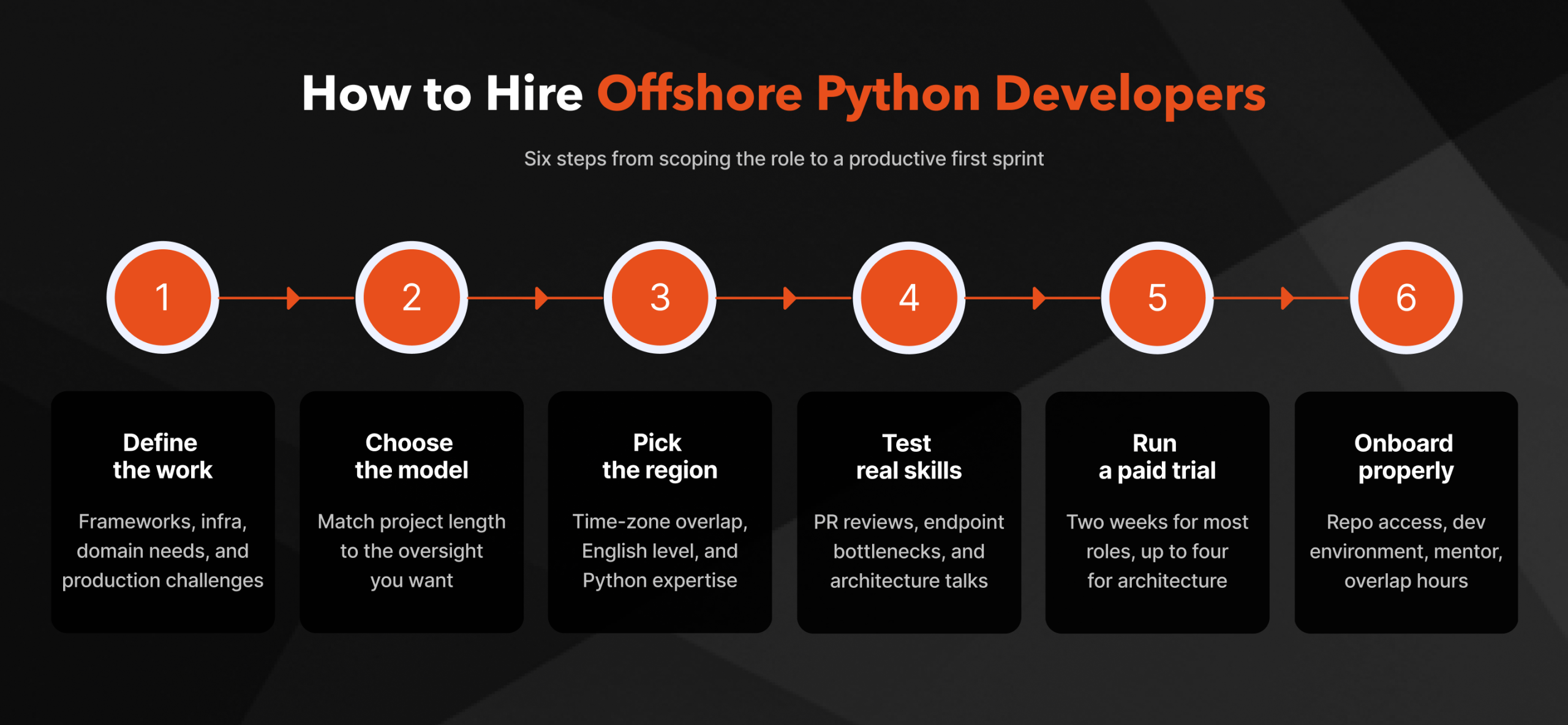
Here’s how to hire offshore Python programmers without spending quarters on interviews and technical tests.
Step 1: Define the work before you define the role
Begin by outlining what the engineer will be responsible for. Make a list of the Python frameworks, infrastructure, domain needs, and production challenges they’ll face.
Saying “We need a senior Python developer” is too vague to secure the right fit. For example, you may need a Django engineer building a SaaS backend, which needs different skills than someone building RAG pipelines with LangChain or handling data with PySpark and Airflow.
Step 2: Choose the engagement model
Define how long your project will take and how much oversight you want to pick the right model.
Freelancers work well for tasks you can assign and get back when finished. Outsourcing is best when you can define the deliverables at the start. Staff augmentation means bringing engineers into your codebase and workflow. Dedicated teams are a good fit for products that need the same people involved over several years.
The goal is to avoid paying for more structure than you need, but also not choosing too little structure for work that needs ongoing attention.
Step 3: Pick the region to fit how your team works
When you hire remote offshore Python developers, don’t pick a region just because of lower hourly rates. Think about time-zone overlap, English skills, available Python expertise, and how much real-time teamwork the job needs.
Latin America is ideal for US teams requiring significant working-hours overlap. Eastern Europe provides less overlap but offers a large pool of data and machine learning talent. With nCube, you are not limited to one region, as we source from a vetted network of over 200,000 engineers across 14 countries.
Step 4: Test how they work in real-life setting
Rather than focusing on Python trivia, have candidates review a pull request from your codebase, identify a bottleneck in a slow endpoint, or explain how they took a system from the first commit to production.
When hiring for senior positions, include one of your engineers in the interview process. This helps you understand how the candidate thinks, communicates, and makes technical decisions, instead of just checking if they can pass a test. At nCube, our engineers handle the live technical assessment and architecture review, so the candidates you meet have already been screened by technical experts, not just recruiters.
Step 5: Use a paid trial for critical hires
A short paid project can really help when growing your team. Ask candidates to do tasks like those they would handle on the job. This lets you see their skills in code quality, communication, documentation, and delivery.
For most roles, two weeks is enough, but jobs with meaningful architecture tasks may need up to four weeks. Even with a trial, you will likely hire faster than most local searches.
Step 6: Onboard them properly
Companies that hire offshore Python developers successfully treat onboarding as part of the hiring process. With that in mind, give offshore engineers access to the same repositories, Jira boards, Slack channels, documentation, and code review process as your in-house developers. We at nCube always help with onboarding engineers into the client’s processes.
Find ways to make the most of overlapping hours from the start, make sure engineers have a working development environment, and connect them with a mentor on your team. The faster an engineer understands the context, the sooner they can contribute.
Know the Python skills you need but don’t want to run the search yourself?
nCube builds offshore Python development teams that plug directly into your workflow. Start with pre-vetted engineers matched to your stack, time zone, and delivery model.
Is offshore Python development right for your project?
Offshore Python development works well when you need skills you can’t find locally or want steady, long-term results. It’s not the best fit if your project needs constant real-time work or your team can’t manage remote engineers.
- Go with freelancers or project outsourcing when you need to hand the software development work off and take back a result. If your project uses proprietary algorithms, financial data, or health information, avoid freelancers and sign air-tight IP agreements with outsourcing vendors.
- Pick staff augmentation services if you already have strong technical leaders but need extra expertise your team lacks, like a specialist for a certain phase or a skill no one covers yet.
- Choose a dedicated offshore Python development team if Python is key to your product, you want to build up domain and codebase knowledge over time, and your plans stretch out for several quarters.
- Offshore hiring is most helpful when you need rare skills. For example, many more candidates for MLOps, RAG infrastructure, distributed training, and production ML reside across different countries than in a single city.
Offshore Python development trends in 2026
The offshore Python market is becoming more demanding. With more Python engineers than ever, expectations for production-ready work are also rising.
#1. AI and machine learning skills are now expected, not just specialized. Companies want Python engineers who can build RAG pipelines, use vector databases like Qdrant or Pinecone, fine-tune large language models, and handle deployment with tools like MLflow. The key difference is whether someone has actually put these AI systems into production.
#2. Nearshoring is becoming more popular when close collaboration is important. US companies increasingly choose Latin America for real-time work, even though this approach is usually pricier than offshoring. EU companies are doing the same, opting for Central and Eastern Europe for better time zone overlap, faster decisions, and less waiting for feedback.
#3. Python and DevOps go hand in hand. Offshore Python teams now often handle post-coding tasks, such as setting up infrastructure with Pulumi or AWS CDK, building Docker images, automating CI/CD, and fixing issues in production.
#4. AI tools are pushing senior engineers to a higher standard. Copilot and Cursor speed up code generation, which makes technical judgment even more important. As a result, the hiring question shifts from “Can this person write Python?” to “Can they design the right system, catch weak AI-generated code, and make sound production decisions?”
#5. Compliance is a key part of choosing where to hire offshore Python developers. You need to look beyond talent and cost. Know where your data will be stored, who can access your systems, which laws apply, and whether your provider can meet GDPR, HIPAA, SOC 2, or data residency needs. For AI products, regulations add extra steps, so you should include compliance in your vendor choices.
Final thoughts
When building an offshore team, start by focusing on the main engineering problem you want to solve. Decide what skills and level of responsibility your project requires and choose an engagement model according to your preferred level of control. Cost matters, but it should come only after you are sure the team is a good fit, can deliver results, and will work well over time.
A lot of people think that just knowing Python is enough, but that’s not the case. For senior positions, it’s just as important to have experience with production systems, good architectural judgment, and a strong understanding of the business domain.
When done right, the decision to hire offshore Python developers becomes a strategic way to access specialists who are hard to find locally while keeping engineering capacity flexible as priorities change. For many teams, it is also a practical way to scale without being constrained by the local talent market.
Ready to hire offshore Python developers? nCube has matched Python teams for 120+ clients over 18+ years.
Tell us the stack, seniority, and skills you need.
Frequently asked questions on offshore Python development from tech leaders
How much does it cost to hire an offshore Python engineer?
What you pay to hire an offshore Python engineer depends on region, seniority, and stack. In Eastern Europe, senior engineers usually earn $55,000 to $80,000 per year.
In South and Southeast Asia, senior developers typically earn $30,000 to $50,000 per year across Bengaluru, Hyderabad, Ho Chi Minh City, and Manila.
Engineers with specialized skills cost more in every region. Those with experience in production machine learning, like RAG systems, distributed training, or MLOps, or who know regulated fields such as PCI-DSS and ledger architecture, usually make 20 to 30 percent more than the senior salary ranges above.
What is the difference between offshore and outsource Python development?
Offshore Python development means building a full-time engineering team in another country that works under your leadership, uses your tools, and contributes directly to your codebase. When you outsource Python development, you let an outside company handle all the software development work using their own resources.
How do I evaluate an offshore Python developer’s skills?
Use a code review, a pair-programming task, and an architecture discussion to assess production judgment, and check GitHub for real ownership, testing, CI/CD, and relevant AI or data work to hire offshore Python programmers without guesswork.
Which countries are best for hiring offshore Python developers?
Eastern Europe (countries like Poland, Ukraine, Romania, Czechia, and Estonia) is a great choice for complex backend systems, algorithm-heavy projects, and advanced AI or machine learning, with strong STEM talent and a European-oriented culture.
South and Southeast Asia, such as India, Vietnam, and the Philippines, have the biggest talent pools and the most affordable rates. These regions are good for hiring at scale, data processing, and round-the-clock delivery, but you will need strong asynchronous processes because of the larger time difference.
What engagement model should I use for offshore Python development?
Freelancers are good for short-term tasks. Project outsourcing works well for clear deliverables. Staff augmentation helps fill skill gaps, and dedicated teams are best for long-term development. A good vendor of offshore Python development service like nCube can help you choose the right model for your project’s needs.
How do I protect my IP when hiring offshore Python developers?
If you plan to hire offshore Python developers, it is important to establish definite rules regarding ownership, access, and security before carrying out any work. You should use non-disclosure agreements and IP assignment agreements and limit access to the production systems and data and maintain compliance with standards such as GDPR or SOC 2. For projects involving sensitive data, include extra safeguards such as code escrow and controlled code repositories to help reduce risk.
Recommended articles


![How to Hire Offshore Python Developers: Costs, Benefits & Best Practices [2026] - image № 5](https://ncube.com/wp-content/uploads/2023/07/contact_form_popup.png "How to Hire Offshore Python Developers: Costs, Benefits & Best Practices [2026] - image № 5")