![How to Hire Offshore Python Developers: Costs, Benefits & Best Practices [2026]](https://ncube.com/wp-content/uploads/2026/09/Web-development-offshore-1.png)
How to Scale AI Projects Faster: Hire Remote AI Developers in 2-6 Weeks


You can hire remote AI developers in four ways: through freelance marketplaces, project outsourcing, staff augmentation, or by building a dedicated team in Europe or LATAM. The hiring process includes 7 stages and starts with defining your AI project needs. The right model will depend on your scope, budget, level of control over the team, your time-to-scale, and the specific role you need, such as an AI developer, ML engineer, MLOps engineer, or generative AI engineer.
Key takeaways:
The right hiring model: freelance marketplaces, project outsourcing, staff augmentation, and dedicated teams differ in control, cost, and scaling speed.
Define the role first: an AI developer, ML engineer, MLOps engineer, and generative AI engineer solve different problems, so scope the work before you source.
Up to 60% lower costs: nearshore regions like CEE and LATAM offer strong AI expertise and a well-educated, English-fluent talent pool at rates well below the US and Western Europe.
2–6 weeks to hire: a defined process onboards a vetted AI developer before competitors lock up the talent.
You’ve got the data. You’ve got the roadmap. But do you have the team?
AI moves fast, and most companies stall not because of tech, but because they can’t find the talent to build it.
Local hiring often isn’t cut out for rapid scaling due to a limited candidate pool, high overhead costs, and scaling constraints, becoming the biggest barrier on the way to Artificial Intelligence adoption.
Companies with strategic scalability in mind are turning to remote hiring models that give them access to a global AI repository, as it’s faster, more flexible, and more cost-effective to hire remote artificial intelligence developers beyond local markets.
In this post, we’ll explore why leading organizations hire AI developers remotely, what skills to look for, the step-by-step guide to hiring in different regions, and real-world examples that prove the success of this approach.
Why hire remote AI developers?
Companies turn to remote AI developers to find specialized talent that is hard to source locally. For roles such as MLOps, LLM fine-tuning, and production RAG or agent architects, demand in 2026 is 3 times higher than supply. By hiring from regions like Central and Eastern Europe or Latin America, businesses can reduce their hiring time from 2-4 months to just 2-6 weeks and save between 40% and 60% on senior AI talent costs.
#1 Access to global AI talent beyond local shortages
Venture capital funding in AI keeps accelerating, which drives the demand for skilled AI engineers. It means the best AI developers (and AI programmers) are up for grabs, and companies are moving fast to recruit them.
As the local talent pool keeps shrinking, companies with smart hiring strategies choose to hire offshore AI developers and deploy nearshore teams to access global Artificial Intelligence expertise.
Brazil is quickly growing its pool of skilled AI professionals. Across Latin America, enrollments in GenAI courses jumped 425% over the past year, which is the highest growth rate worldwide, according to Coursera. This trend is giving businesses better access to top Brazil nearshore developers with the skills they need.
The same report finds that Argentina and Colombia consistently outperform globally in Machine Learning, Data Science, and Mathematics. Thus, AI developers in the region are a strong choice for AI model development.
CEE is another hotspot to consider for your AI solutions. Countries like Poland, Romania, and Ukraine are vast repositories of top AI developers with diverse expertise. Between 2020 and 2024, 34 new AI companies were founded in Ukraine, bringing the total to 243, the second highest in the region:
- Poland: 301 Artificial Intelligence companies
- Ukraine: 243
- Czech Republic: 121
- Romania: 109
Thus, nearshore locations like CEE and LATAM let you build your IT team and AI units with up to 60% lower operational costs. That brings us to the next point.
#2 Cost advantages
Internal hiring gives you control but comes with higher long-term costs. The US and Western Europe have some of the highest labor costs in the world. Beyond salaries, you’ll need to cover added expenses like bonuses, benefits, and overhead. Hire locally, and it’ll inevitably consume a large portion of your software development budget.
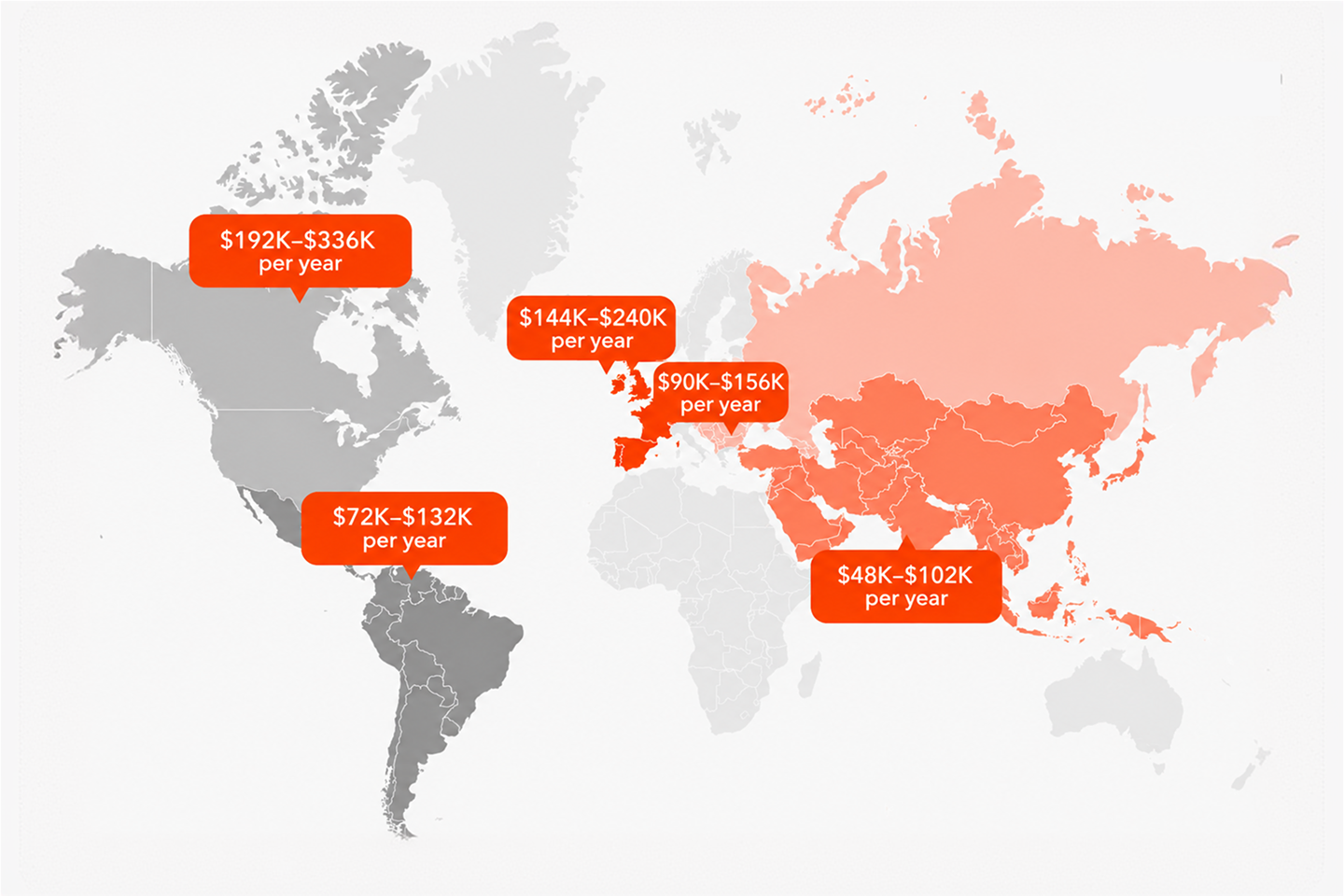
AI developers in the US, for instance, can earn, on average, ~$220,000 total compensation at senior roles.
In contrast, AI developers in CEE typically bring home $40,000–$120,000, depending on location and experience.
In LATAM, salaries for AI developers range between $30,000–$100,000, based on seniority and country.
That said, even when hiring at the top of the local market, remote AI developers still cost 40–60% less than those in your home region.
Want to cut AI development costs by 60% without losing quality?
Essentially, a vendor like nCube will help you add AI developers who are well-educated, have a history of engineering expertise, a strong technical background, and remote experience.
#3 Flexibility: project-based, part-time, or full-time
Traditional hiring can be impractical, as it locks you into maintaining a high-cost permanent team, even when workloads shift.
To hire remote AI developers means you have full control over how and when you scale. You can bring in developers for a few sprints, a defined project, or long-term employees, depending on what your roadmap needs at the moment.
So, whether you need a natural Language Processing (NLP) expert to fine-tune a model or a Data Scientist to prepare AI models for an upcoming release, you’ll pay only for the hours or months your developer actually contributes. Staffing, payroll, HR support, and retention expenses will be covered by a vendor of AI engineers like nCube.
#4 Distributed AI teams are becoming the norm
The competition for local AI and machine learning engineers is fierce. That’s why distributed AI teams are becoming standard for companies scaling their AI projects. With overlapping time zones in CEE and LATAM, teams have sufficient daily interactions, solve blockers in real-time, and maintain around-the-clock development, passing tasks between regions.
The advantages are clear: you gain access to talent with specialized skills, deep AI knowledge, and a balance of cost-efficiency and quality. This model also lets your internal experts stay focused on product vision and strategy while distributed engineers handle execution and iteration.
#5 Specialized roles you can’t fill from a single local market
An enterprise AI stack today needs four specialists, and they’re now among the hardest roles on the market to fill. In ManpowerGroup’s 2026 Talent Shortage Survey of 39,000 employers across 41 countries, AI skills overtook engineering and IT to become the scarcest capability worldwide for the first time, with AI model and application development ranking as the single hardest skill to source.
- A Data Scientist curates, checks, and interprets the domain data your models rely on, which is the kind of work you can also handle through data science outsourcing.
- An ML Engineer designs and trains custom model architectures.
- A Generative AI or LLM Engineer fine-tunes models, builds evaluation tools, and adds RAG and agent features.
- An MLOps Engineer deploys, monitors, and retrains models in production while managing inference costs.
Trying to hire all four roles in one city can take 3-6 months for each position. By tapping into remote talent networks in LATAM and CEE, you can reach a far larger pool, reduce hiring time to 2-6 weeks, and lower senior-level costs by 40-60%.
Which AI role do you actually need?
The AI role you need depends on how far your project has come, since each role handles a different step in turning data into a working product. To hire AI engineers who fit, match the role to your project’s stage: Data Scientist, ML Engineer, Generative AI Engineer, MLOps Engineer, or AI Developer. Here’s how to define it:
If your data is messy or unlabeled, a Data Scientist will clean, check, and organize it, because nothing else can happen until the data is solid. Once your data is ready but you still need a model, an ML Engineer will build and train one for you. If you want to customize existing large language models using RAG, fine-tuning, or agents, a Generative AI Engineer is the right fit.
When your model works and just needs to run smoothly at scale, an MLOps Engineer will deploy, monitor, and retrain it in production. If you only need to connect a ready-made model to your product, an AI Developer can hook up the vendor API to your app.
If your data is messy or unlabeled, a Data Scientist will clean, check, and organize it, because nothing else can happen until the data is solid. Once your data is ready but you still need a model, an ML Engineer will build and train one for you. If you want to customize existing large language models using RAG, fine-tuning, or agents, a Generative AI Engineer is the right fit.
When your model works and just needs to run smoothly at scale, an MLOps Engineer will deploy, monitor, and retrain it in production. If you only need to connect a ready-made model to your product, an AI Developer can hook up the vendor API to your app.
| Role | Primary focus | Typical output | When to hire |
| Data Scientist | Governing the data foundation the models depend on | Curated and validated datasets, exploratory analysis, data-quality metrics that reduce bias and hallucination | Your data is messy, unlabeled, or untrusted before any model can use it |
| ML Engineer | Designing and training custom machine learning models from scratch (PyTorch, TensorFlow) | Deep learning or tabular models, feature engineering, latency-optimized inference (vLLM, TensorRT)v | Off-the-shelf models can’t solve your problem and you need a bespoke one |
| Generative AI Engineer | Building LLM and agent architectures with RAG, fine-tuning, and orchestration (LangChain, LlamaIndex, CrewAI) | Multi-agent systems, RAG pipelines over vector databases, NLP features, chatbots, and fine-tuned open-weight models (Llama, Mistral) | Hire LLM engineers or model-specific specialists when your product depends on custom LLM behavior, retrieval, or autonomous agents |
| MLOps Engineer | Running model infrastructure and continuous delivery in production | Automated retraining pipelines, containerized deployments (Docker, Kubernetes), model registries (MLflow), cost and performance monitoring | Your models are built but need to run reliably and scale in production |
| AI Developer | Integrating existing models into your product through vendor APIs (OpenAI, Anthropic, Bedrock) | Working AI features in your app: function calling, client-side streaming, backend and frontend integration | You want to add AI to a product without training your own models |
What an actual AI team looks like: Two examples
Here’s how these roles drive results in two common AI projects.
Building a B2B SaaS RAG product, for instance, an assistant that answers questions from customer documents, usually takes a core team of about 4 people: a Generative AI Engineer + an AI Developer + a Data Scientist + an MLOps Engineer.
The most important hire is a Generative AI Engineer who builds the retrieval pipeline over a vector database, tunes prompts, and runs evaluation to keep answers grounded in your data.
You’ll also need an AI Developer to connect the assistant to your product using model APIs, a Data Scientist to clean and split up the documents the system uses, as well as an MLOps Engineer to keep latency and token costs low once real users start using the product.
Since you’re using pre-trained models, you usually don’t need an ML Engineer.
With a good vendor network (like nCube’s 50,000 AI engineers across Europe and LATAM), you can staff a team like this in 2-6 weeks.
For a computer vision or production ML project, like detecting defects in a live video feed, you’ll want an ML Engineer to design and train the custom model.
A Data Scientist will handle data labeling and make sure the data is accurate. An MLOps Engineer is important for ongoing monitoring and retraining as things change.
An AI Developer connects the model’s output to your app. In these projects, generative AI skills usually aren’t the main focus.
Skills to look for in remote AI developers
Strong remote AI developers combine technical depth (programming, ML frameworks, data handling, deployment, and MLOps) with the remote-work skills that keep a distributed team productive: clear communication, autonomy, and cultural fit.
Core technical skills

- Programming languages
AI engineers need a firm grasp of one or more languages your project requires, typically Python, R, C++, or Java. If you plan to hire remote neural network developers, prioritize Python for building and deploying deep learning models fast (particularly when leveraging nearshore Python developers who can accelerate delivery across time zones), R for analytics and research, C++ for performance-critical components, and Java for integrating AI into large enterprise systems.
- Artificial Intelligence /Machine Learning frameworks
Many organizations use TensorFlow, PyTorch, and Scikit-learn because they help move projects from prototype to production quickly. Make sure your offshore AI developer has practical experience with these key Python frameworks.
- Data skills
If your project uses company data, it needs to be cleaned and organized before modeling. Find developers who can handle ETL processes, work with large datasets, and use modern data tools to keep pipelines reliable and efficient.
- Model deployment | Cloud
Building a model is just part of the job. Strong AI engineers can package models with Docker, deploy them on AWS, GCP, or Azure, manage scaling with Kubernetes, and monitor and retrain models as data changes.
MLOps | Automation
Keeping models working well over time requires MLOps skills, which connect data science and DevOps. Look for people who know CI/CD pipelines, model versioning, and deployment automation to keep your models reliable and ready for new data.
Remote-friendly skills
- Communication skills
AI developers work with many people, including business analysts, project managers, data engineers, and product owners. They need to explain ideas clearly. Good English skills and the ability to work well asynchronously are important. Look for people who spot problems early, respond quickly, are open, and keep good records.
- Autonomy | Ownership
Fast-moving projects need developers who can work independently, take ownership of their work, and set clear priorities with minimal supervision.
- Cultural fit
External AI developers may come from different backgrounds, so it’s important that your company’s vision and values match theirs. Look for people who are open to feedback, emotionally intelligent, culturally sensitive, and able to adapt to your work culture.
What skills should a generative AI developer have?
When hiring a generative AI developer, you don’t need someone who can build foundation models from the ground up. Instead, look for an engineer who can work with systems like OpenAI’s GPT models, Anthropic’s Claude, or open-weight models such as Llama and Mistral, and adapt them to fit your business needs using APIs, custom data, and clear processes. It’s important that they have practical experience with prompt engineering, natural language processing (NLP), retrieval-augmented generation (RAG), and fine-tuning models on data specific to your field.
Top generative AI engineers do more than build prototypes. They know how to run these systems in production: building RAG pipelines with hybrid search and production vector databases, managing multi-agent workflows with tools such as LangGraph or CrewAI, and setting up ways to measure accuracy, reduce hallucinations, and track token usage.
When you hire a generative AI engineer, focus on candidates who have real experience working in production. They should know how to manage token costs, guard against prompt injection, and keep systems running smoothly with real users, not just create impressive demos.
How to hire remote AI developers: Step-by-step
Hiring remote AI developers takes seven steps: outline your AI needs, select a vendor, define the engagement model, run joint interviews, agree on contracts and compliance, onboard the team, then manage and scale with vendor support.

Step 1. Outline your AI needs
Start by outlining your case: whether it’s programming an NLP chatbot, computer vision model, recommendation system, anomaly detection, forecasting tool, RAG assistant, or LLM fine-tuning. The more precisely you outline the team composition, skill sets, and technologies needed, the less it will take to find fitting AI experts.
Step 2. Select the right vendor
Learning how to choose a machine learning development company pays off here: a solid vendor (including us) can build a team of AI engineers who truly match your needs for AI technologies, and prioritize staffing speed, team integration, and developer retention.
Importantly, see if they can build teams within your time zone. For example, at nCube, we cover both the CEE and LATAM nearshore regions, ensuring real-time collaboration with EU and US teams.
Finally, review their legal and compliance standards, including data protection, IP ownership, and NDA practices.
Step 3. Define the engagement model
- Dedicated Team
Want to stay in control over the development processes within global delivery? Then, Dedicated Team is a fitting model. It lets you manage the project with close oversight and direct collaboration with external AI developers. It works the same way as an offshore dedicated development team, applied to AI roles.
- Staff augmentation
If your team lacks specific Artificial Intelligence expertise, for instance, Machine Learning, generative AI, or Computer Vision, AI staff augmentation can fill those vacancies fast. The biggest pro of remote IT staff augmentation services is flexibility and adaptability: you can add specialists when needed and scale down or disband the team once the project is complete.
- Project-based outsourcing
Offload the entire Artificial Intelligence project to a vendor and focus on strategy and product vision while they handle the entire SDLC. It’s a practical way to validate an idea, build an MVP, or launch a pilot.
- Hybrid / Flexible models
How to make both internal teams and vendors work to your advantage at the same time? Keep a core team of full-time AI developers to handle ongoing processes while plugging vendor-provided niche specialists into specific development stages. This lets you hire as needed, maintain control over processes, and avoid the cost of overstaffing.
Step 4. Conduct joint interviews
Working closely with your vendor during interviews helps you find an AI developer who can deliver the results you want. At nCube, we pre-screen candidates for technical skills and culture fit, including English and people skills, so you only meet the best AI engineers. We match your interview process and handle scheduling, communication, and coordination, and if a candidate isn’t right, we quickly suggest others. You always make the final call.
The vendor confirms that candidates are qualified. Your interviews ensure they can succeed in your specific environment, using your technology and meeting your requirements. These questions support that assessment:
- Technical assessment: Give a practical task with real challenges, like handling unpredictable model outputs or debugging an agentic tool loop, not syntax trivia. Watch how they use AI coding assistants to write and check code.
- Role-specific depth: A generative AI engineer should be comfortable talking through multi-agent orchestration and RAG. An ML engineer should know model optimization and custom training. An MLOps hire should be able to walk you through deployment, retraining, and observability.
- Production experience: Ask what they’ve shipped to real users, and how they measure accuracy, monitor hallucinations, and manage cost and latency in production.
- Token economics: Candidates should know how to keep costs and response times under control as usage increases. They can do this with prompt caching, model routing, and streaming. If this is missed, you could end up with high API bills or a slow product.
- Security and governance: Check if candidates can prevent prompt injection, control access, and protect your intellectual property when customer data is involved. Small gaps in these areas can become major issues once the system is live.
- Async collaboration: Since most work happens without everyone online at the same time, ask candidates how they document decisions and share their thought process in writing. This habit helps distributed teams stay productive across time zones.
Also, watch out for red flags. In particular, be cautious of candidates who only show static portfolio demos but can’t explain their evaluation metrics, don’t consider token and API costs at scale, lack experience with model edge cases in production, or rely on high-level frameworks without understanding how the underlying models work.

Step 5. Agree on contracts and compliance
Understandably, risk management is such an essential part of working with vendors. Always define the legal framework of cooperation before you hire an AI developer. This includes an NDA to ensure your code, models, and data remain confidential. Clear IP ownership terms should state that your codebase, documentation, architecture, and know-how stay yours.
Another key aspect is compliance with security standards. If your company handles customer data, make sure the vendor can provide proper access control, encryption, secure storage, and regular security audits, along with a commitment to responsible AI development.
Step 6. Onboard remote AI developers
Distance isn’t a barrier to delivering quality products, but successful onboarding is the first step to achieving it. It helps team members feel unified from the start. Make sure new AI developers get access to all essential tools like GitHub, Jira, Slack, CI/CD platforms, and cloud environments such as AWS, GCP, or Azure.
Next, help them understand your internal workflows: how stand-ups, code reviews, deployments, and retrospectives go, as well as introduce them to your team’s culture. A good practice is to assign a mentor to guide new team members and help them integrate into your processes.
Step 7. Manage and scale with vendor support
A vendor like nCube acts as your sidekick in your team’s integration and further growth. We provide ongoing HR support, assist with team communication, and focus on long-term retention of your developers. Our recruitment team also maintains a dedicated candidate pipeline tailored to your project, so when it’s time to hire and scale, you can rely on a pipeline of strong AI engineers.
Choosing your hiring model
After you have identified the roles you need, the next step is to decide how to bring people on board. Marketplaces and freelancers work well for one-off, clearly defined tasks. Staff augmentation (AI developer staffing via a provider like nCube) helps fill a skill gap within your current team. Project outsourcing is best when you want to hand over a specific project. A dedicated team is ideal for managing a long-term product. The table below shows how these options compare on the most important factors.
| Model | Best for | Control over project | Vendor responsibility | Scaling | Pricing |
| Freelancers / marketplaces | Isolated, short tasks and quick prototypes | Task-level | Minimal: client manages the work | Limited | Per task / hourly |
| Staff augmentation | Filling a specific skill gap on an existing team | High | Employment, payroll, retention | High | Hourly / monthly |
| Project outsourcing | A defined MVP, PoC, or module | Low | Full delivery | Limited by scope | Fixed / per milestone |
| Dedicated team | Long-term AI products and core IP | High | Recruitment, HR, payroll, retention, overhead | High | Monthly |
A dedicated team is the best-fitting model for a long-term AI product. It’s how you hire dedicated artificial intelligence developers who work as a permanent part of your team, while the vendor handles hiring, retention, and overhead, and you keep control of daily operations.
Compare AI hiring models before you commit
See how dedicated teams, staff augmentation, project outsourcing, and freelancers differ in control, cost, and vendor support — and which fits your timeline and budget.
The cost of hiring AI developers
The cost to hire AI developers ranges from about $25 to over $200 per hour, depending on where you hire and their level of experience. Remote developers in Central and Eastern Europe or Latin America usually charge 40-60% less than those in the US. In the US, a senior AI engineer now earns about $206,000 on average, and specialists in generative AI or large language models can earn up to 60% more.
AI developer rates by region
| Region | Junior (0-2 yrs) Hourly Rate | Mid-Level (3-5 yrs) Hourly Rate | Senior / Lead (5+ yrs) Hourly Rate | Approx. Annual Cost (full-time) |
| North America | $60-$100 | $100-$150 | $150-$200+ | ~$150K-$220K+ |
| Western Europe | $50-$90 | $80-$120 | $120-$160+ | €70K-€130K |
| Central & Eastern Europe (CEE) | $30-$60 | $60-$100 | $100-$160+ | $60K-$130K |
| Latin America | $25-$50 | $50-$100 | $100-$160+ | $50K-$130K+ |
| Asia | $20-$50 | $50-$100 | $100-$160+ | $40K-$110K+ |
These figures reflect hourly bill rates from a staffing vendor. Rates are based on 2026 market ranges and vary by specialization, seniority, and time-zone overlap. Specialists in Generative AI, LLM, and MLOps are billed at the top of each range. The annual-equivalent column indicates the full-time equivalent of each hourly rate.
Factors influencing cost
- Seniority and experience
Junior AI developers deal with data preparation, optimization of existing Machine Learning algorithms, feature engineering, and automation of small tasks. Senior-level hires go beyond that, owning system design and architecture, covering LLMs, Computer Vision, and MLOps.
Years of commercial experience also directly impact how much AI developers take home as well as the kind of technical skills they bring and how efficiently they work. While junior AI developers may seem cost-effective, the real cost can be time spent on training and oversight, causing a slower time-to-market. Senior AI engineers, on the other hand, come with a higher salary but often reduce the development time and risks of rework.
- Specialization
When planning your budget, consider the type of AI developer you need to hire. If you’re building complex AI components, it’s best to budget for niche skill sets or a mix of expertise, for example, combining NLP specialists with MLOps engineers.
The highest paying AI roles include:
- AI Architect / Lead Machine Learning Engineers
- Applied Natural Language Processing / LLM Engineers
- Artificial Intelligence Research Scientist
- Computer Vision Engineer
- MLOps Engineers
- Generative AI Engineers
- Geography
The rates of AI developers vary by region and are shaped by the cost of living, demand for talent, and the maturity of the local IT market. For example, an AI developer in the Bay Area can charge 2-3 times more than an equally skilled remote developer in CEE or LATAM. In our experience, these regions offer the best cost-to-quality balance, large pools of highly educated developers, diversity of skillsets, and overlapping time zones that support real-time collaboration.
- Engagement model
How you hire your AI developers defines the total cost of development. The most common options are:
Full-time dedicated team: AI developers hired under this model are usually mid- or senior-level experts with strong experience who work as full-time members of your team. You pay only for their time, while the vendor handles hiring, retention, legal setup, and overhead. This model gives you full control over workflows and ensures deep integration into your processes. While the upfront cost may be higher, it’s more cost-effective in the long run, since you cut back on administrative, recruitment, and infrastructure expenses.
Project-based augmentation: This model lets you bring in AI developers for short-term initiatives such as proof of concept (PoC), MVP, or integration of a specific AI module. It’s ideal when you need to hire specialists like MLOps to fine-tune pipelines or data scientists to experiment with LLMs. This is a cost-efficient option that features a quick time-to-hire but requires a clearly defined scope and strong oversight on your side.
- Time-zone alignment
The closer AI engineers are to your location, the higher their rates will be. Daily real-time interaction adds significant value, as it helps resolve blockers instantly and keeps teams in sync. Our nearshoring model strikes the perfect balance: for US companies, LATAM provides 4-8 hours of overlap, while CEE shares similar or adjacent time zones with Western Europe. Admittedly, nearshore AI squads are a bit pricier than offshore in Asia, but synchronized communication often outweighs the financial aspect.
Hidden costs in remote hiring
Onboarding: Successful onboarding takes a clever combination of internal management and vendor support. While your internal team sets the tone, a vendor like nCube helps establish clear communication channels and ensures a smooth start. On your side, it’s key to use role-based onboarding scenarios for each AI developer, providing access to tools and documentation. A manager within your organization should also guide new developers through your workflows and culture to help them integrate quickly and effectively.
IT infrastructure: Licensed software, VPN access, cloud environments, and secure communication channels are essential for external setup, though they can increase the overall cost per developer. At nCube, we remain flexible and can provide or adapt the IT infrastructure for AI software development to match your specific security and compliance needs.
Vendor’s fee: At nCube, the vendor’s fee covers a comprehensive suite of services, including staffing, overhead, IT infrastructure, tools, HR, retention, and on-the-ground developer support. This approach ensures long-term stability and high developer tenure (averaging 3.5 years). Thus, when you hire remote development team with us, you’ll work with a consistent unit of AI engineers that grows with your product.
Real results: Scaling AI delivery for Veritone
At nCube, we’ve been building nearshore AI teams since 2017, partnering with companies like Veritone, Fetch AI, VidMob, and Charles AI. With a proven track record and a vast network of AI developers across Europe and LATAM, we know how to help businesses launch and scale their Artificial Intelligence initiatives.
For instance, Veritone created aiWARE, one of the first enterprise AI operating systems, to turn unstructured audio, video, and text into useful insights. Their product managers were in California, but the offshore team in India struggled to keep up. The time difference made it hard to deliver on a challenging video recognition platform.
nCube put together a dedicated six-person team for AI development, back-end work, and QA, with engineers skilled in Node.js, Python, Docker, and Flask in Europe. This team took charge of key aiWARE components and worked within Veritone’s Agile process as part of the client’s team. By operating from Europe, they solved most of the coordination issues that the India team faced.
Use Case
nCube x Veritone: AI Product Development
We integrated a team of elite AI engineering talent.
Ready to scale your AI projects? Hire remote AI developers
Access our pool of 50,000+ AI developers: We maintain a network of pre-screened AI professionals based in Europe and Latin America, including a strong talent base of nearshore developers Romania, Poland, Brazil, Colombia, and other talent hubs. With us, you can find AI engineers with the exact skills your project needs, handpicked to align with your technologies, budget, and time zone.
Work directly with your AI engineers: Your AI developers operate fully within your processes and under your lead, while nCube manages IT infrastructure, payroll, HR, retention, and legal support. You get the control level of a direct hire over priorities, workflows, and leadership, without the administrative burden of employing the team yourself.
Hire AI engineers with complex skill sets: Whether you need to hire remote chatbot developers, NLP researchers, remote NLP developers, Computer Vision engineers, or deep learning infrastructure experts (or other developers for hire), we let you quickly source top-tier specialists for even the most hard-to-fill positions.
Accelerate your hiring cycle by 60%: When you hire remote AI engineers with us, we reduce your time-to-hire from months to just 2-6 weeks. You’ll meet only high-fit AI engineers who passed our rigorous screening for technical expertise, English fluency, communication skills, and cultural alignment.
Retain 100% of your team for as long as you need: Our retention-first model that covers an IT community, bonuses, benefits, and continuous engagement keeps your AI experts onboard for 2.5-5 years – from kickoff through product launch and beyond.
Why companies like Veritone, Charles AI, and Fetch AI choose nCube:
✅ 2–6 weeks to build nearshore AI teams
✅ 50,000+ pre-vetted AI devs across CEE & LATAM
✅ Expertise in: NLP, CV, Generative AI, MLOps, LLM fine-tuning
✅ Embedded into your process, fully remote
✅ Average retention = 3.5 years
FAQ
Frequently asked questions about remote AI developers
Why should I hire remote AI developers instead of local ones?
When you hire remotely, you get access to a global talent pool of AI developers with specialized skills such as MLOps, Computer Vision, or Generative AI. Whether you need to hire AI engineers for machine learning projects or a full product build, you can cut time-to-hire, scale teams up or down as your AI solutions evolve, and achieve more within limited budgets, with AI engineers equal to your home-based ones in expertise.
How long does it take to hire a remote AI developer?
A provider like us with a vast network of AI and machine learning developers, and DS developers in Europe and LATAM is likely to close your skill gaps and hire within 2-6 weeks after the initial call. We’ll send you 1-2 CVs of high-fit AI engineers within 48 hours.
What does it cost to hire an AI developer?
The answer varies with where you build and who joins the team. With nCube, experienced AI developers in CEE and LATAM typically range from around $25 to $160+ per hour, depending on seniority and specialization — see the rate table above for a full regional breakdown. Share your target developer profiles and we’ll estimate your actual cost more precisely.
What are the hidden costs of hiring remote AI developers?
In addition to hourly rates, watch out for hidden costs like onboarding time, IT infrastructure such as licensed software, VPNs, and cloud services, as well as the vendor’s fee. The best vendors include infrastructure, HR, retention, and support in a single clear rate. This helps you sidestep unexpected expenses and keeps your team stable over time.
What is your process for vetting AI talent?
Our vetting process is guided by your requirements when you hire artificial intelligence engineers, so you get a match on both skills and culture fit. To hire the best generative AI developers, every candidate passes a tech interview with our internal AI developer, along with soft skills, culture fit, and English assessments, so you only meet high-fit AI developers. The decision to hire is always yours.
What common hiring mistakes should companies avoid when hiring external AI developers?
A recipe for disaster is to overlook communication skills and culture fit when you hire AI engineers: two things we see as essential at nCube during pre-screening, as they are key for distributed work. Companies should also make an effort to integrate external Artificial Intelligence developers into their tools, routines, and culture, treating them as a true part of the team.
What is the best way to hire AI talent remotely?
The right way to hire remote AI talent depends on your project, but a good starting point is to clearly define the role you need, pick a vendor who can find candidates in your time zone, hold interviews together, and agree on contracts and IP terms before onboarding. Most companies choose remote AI developer staffing through a partner in CEE or LATAM instead of direct hiring in local markets, since a trusted network can fill roles in just a few weeks and takes care of payroll, compliance, and retention.
Where can I find experienced AI engineers to hire for a short-term project?
If you have a short-term project like a proof of concept, MVP, or a single AI module, use staff augmentation or hire a freelance specialist.
Freelance marketplaces are a good place to find AI developers for small, clearly defined tasks. If your project needs several experts or advanced AI skills, staffing vendors can put together a team for you.
For longer-term AI projects, nCube can help you start with one engineer and add more specialists as your needs change.
Marketplace, freelancer, or dedicated team: which is best for hiring AI developers?
Freelancers and marketplaces like Upwork or Toptal work well for short, simple tasks such as prototypes, basic API wrappers, or dataset labeling.
So, if you just need to hire an AI developer for a small-scale custom project, a freelance specialist on a marketplace works. However, avoid using them for core infrastructure, since sensitive AI work involves real data privacy and IP risks.
Staff augmentation is a good fit if you have an established team and need to add a specific skill, like an MLOps or RAG specialist, while still keeping daily control.
Choose a dedicated team for long-term AI products and proprietary IP, where one group manages the entire model lifecycle. In general, freelancers are best for short, contained tasks, while dedicated teams are better for ongoing, strategic projects.
Recommended articles