How to Scale an Engineering Team from 8 to 25 People Without Slowing Down Delivery



You gave the green light to grow your team, expecting to ship more this quarter. Ironically, productivity drops before a new hire even submits their first pull request.
Many engineering leaders run into this problem when scaling engineering teams. Top engineers get pulled off critical features to help new teammates get started. Sprints slow down because there’s more to coordinate. The undocumented architecture starts to show its weak spots as new people join.
Instead of shipping faster, you spend the quarter protecting your core team’s output.
This guide shows what to do after you sign the offer letters. Whether you’re growing from 8 to 12, 12 to 18, or 18 to 25 developers, you’ll find a composition model for each step. The guide also compares three hiring models and shows how to bring in 5–10 new engineers without slowing down your current sprint. You’ll walk away knowing how to set up squads so things don’t fall apart past 15 people.
If you have a headcount and only 90 days to work with, read on.
Why scaling an engineering team is harder than hiring
Coordination overhead, not headcount, is the main reason engineering teams slow down when scaling past 12 people. At 5 engineers, coordination happens informally in Slack. At 12+, informal coordination breaks down and requires defined ownership structures.
Scaling can look like a simple hiring challenge, but new engineers often end up on teams with fuzzy boundaries, unclear ownership, and tech leads already stretched thin.
This is a structural problem your recruiters cannot solve. Hiring faster just puts new hires into a system that isn’t ready for them.
Adding more engineers without changing how you work isn’t scaling. It’s just making things more crowded. Change the structure first, and those new hires will start making a difference in weeks instead of months.
At what team size does engineering coordination break down: 5 failure modes between 8 and 25 people
#1 Coordination often breaks down once your team grows past 12 people.
Without clear boundaries, no engineer can rule anything out as “not my problem,” so everyone makes a futile attempt to keep up with everything.
Key rule: Define your team topology and squad boundaries before you hit 12 engineers. Fixing team structure reactively after productivity drops takes twice as long.
#2 Onboarding new engineers drains your tech leads’ capacity.
Each time you bring on a senior hire, it takes up about 15 to 20 percent of a tech lead’s time for four to six weeks. This matches what Brooks’s Law points out: adding new people means more coordination and mentoring before you see extra results. If you onboard three engineers at once, that can quietly take up half of the lead’s workweek. If you don’t plan for this, you’ll notice sprint commitments start slipping, even if it’s not clear why.
Key rule: Reserve explicit onboarding capacity in sprint planning before the first new hire starts.
#3 Undocumented architecture gets brittle as the team grows.
When your team is about 8 people, architectural decisions are shared informally via Slack rather than being formally written down. New engineers join without that background, try to figure out the rules on their own, and soon the codebase ends up with conflicting solutions to the same problem.
Key rule: Map out clear ownership and define API contracts before you start growing the team, not while you’re in the middle of onboarding.
#4 Communication overhead grows faster than your team.
Communication paths grow much faster than headcount (8 people have 28 possible one-on-one connections, 14 have 91). Without strict async habits, every path turns into a meeting or ping, so engineers lose focus time, seniors get interrupted most, and the team ends up communicating more, not better.
Key rule: Once your team grows to 10 people, it’s a good idea to start using async-first communication rules instead of waiting until you reach 20.
#5 Process debt accumulates until it breaks delivery.
A process that works well for a team of 8 can start to fall apart as your team grows. Meetings that used to be quick can drag on, the backlog can become a struggle among different workstreams, and old habits may persist until someone points out the hidden costs.
Key rule: Whenever your team reaches a new threshold, like 12, 18, or 25 people, take a moment to review your processes. Prune unnecessary meetings and re-align workflows.
Engineering team composition model by scaling stage
Scaling an engineering team from 8 to 25 is far more about timing than sheer headcount.
Managers, QA, DevOps, data, and security: you know you will need these roles on your team at some point. The question is when to add them. Add too early, and you pay for overhead; too late, and you’ve built a bottleneck.
The model below shows three stages, explaining which roles to add, when to add them, and why they matter. Start by finding your current team size.
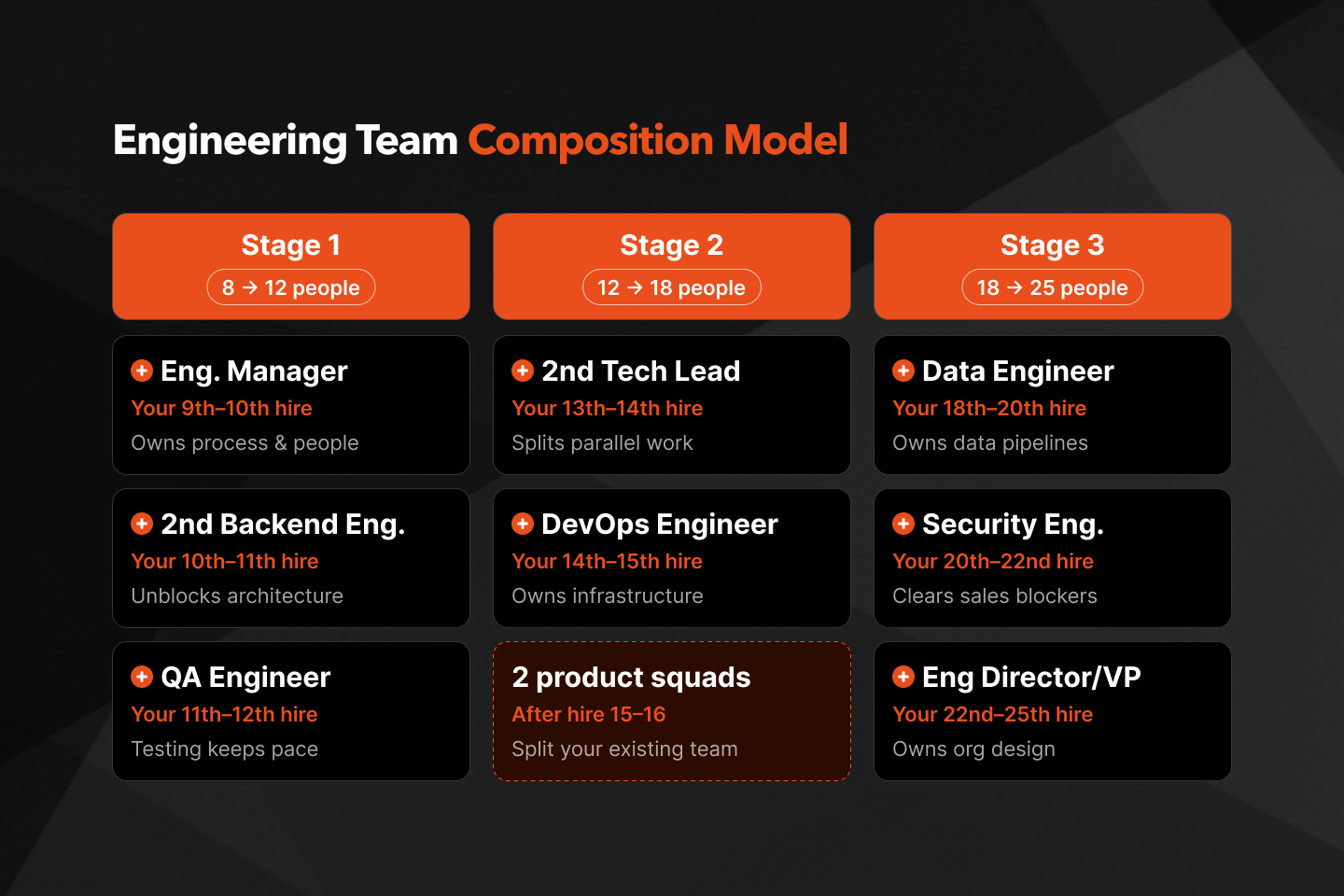
Stage 1: 8 → 12 people
| Role to add | Timing | Why now |
| Engineering Manager | At person 9–10 | Informal leadership breaks down; someone needs to own delivery process and people ops |
| 2nd Senior Backend / Platform Engineer | At person 10–11 | Architecture decisions accumulate; one senior engineer is a bottleneck |
| QA Engineer | At person 11–12 | Manual testing can no longer keep pace with sprint output |
Between 8 and 12 people, teams add an Engineering Manager at person 9–10, a second senior backend engineer at person 10–11, and a QA engineer at person 11–12.
Stage 2: 12 → 18 people
| Role to add | Timing | Why now |
| Second Team Lead / Tech Lead | At person 13–14 | One team lead cannot manage two parallel workstreams without velocity cost |
| DevOps / Platform Engineer | At person 14–15 | Infrastructure becomes a shared bottleneck; needs dedicated ownership |
| Product-aligned squads (2×) | Structural, not headcount | Formal squad topology prevents coordination collapse at 15+ people |
Between 12 and 18 people, teams typically add a second Team Lead (person 13-14), a dedicated DevOps/Platform Engineer (person 14-15), and split into two product-aligned squads: a structural change rather than a headcount addition.
In Stage 2, you make this split intentional and assign people to each stream. For instance, you need a second tech lead to manage the new stream, since one person can no longer handle both areas.
A dedicated DevOps engineer should now handle the infrastructure tasks that senior backend developers were previously managing alongside their main work.
Splitting your engineers into two product-focused squads won’t increase your headcount, but it prevents the coordination collapse that might happen with a 15+ team.
Stage 3: 18 → 25 People
| Role to add | Timing | Why now |
| Data Engineer | At person 18–20 | Analytics and data pipeline work can no longer be absorbed by backend engineers |
| Security / Compliance Engineer | At person 20–22 | Security reviews become a blocker for enterprise sales and Series B diligence |
| Engineering Director or VP Eng upgrade | At person 22–25 | Strategic org design, cross-team alignment, and board-level reporting require a dedicated executive |
In Stages 1 and 2, you added coordination roles to your engineering team composition, such as managers, leads, and squads. In Stage 3, the team gains more depth.
Between 18 and 25 people, teams add a Data Engineer at person 18–20, a Security/Compliance Engineer at person 20–22, and upgrade to an Engineering Director or VP of Engineering at person 22–25.
When your team reaches 22 to 25 people, leadership also needs a dedicated owner. Organizational design and board reporting now require a full-time executive, whether that means hiring an engineering director or bringing in a more senior VP of Engineering.
Three paths to scale: In-House, Staff Augmentation, Nearshore Dedicated Team
When choosing a scaling model, most CFOs weigh the budget carefully and underweight the timeline. Here is what each path actually delivers and what it costs.
Timeline and cost comparison: 10-engineer scaling scenario
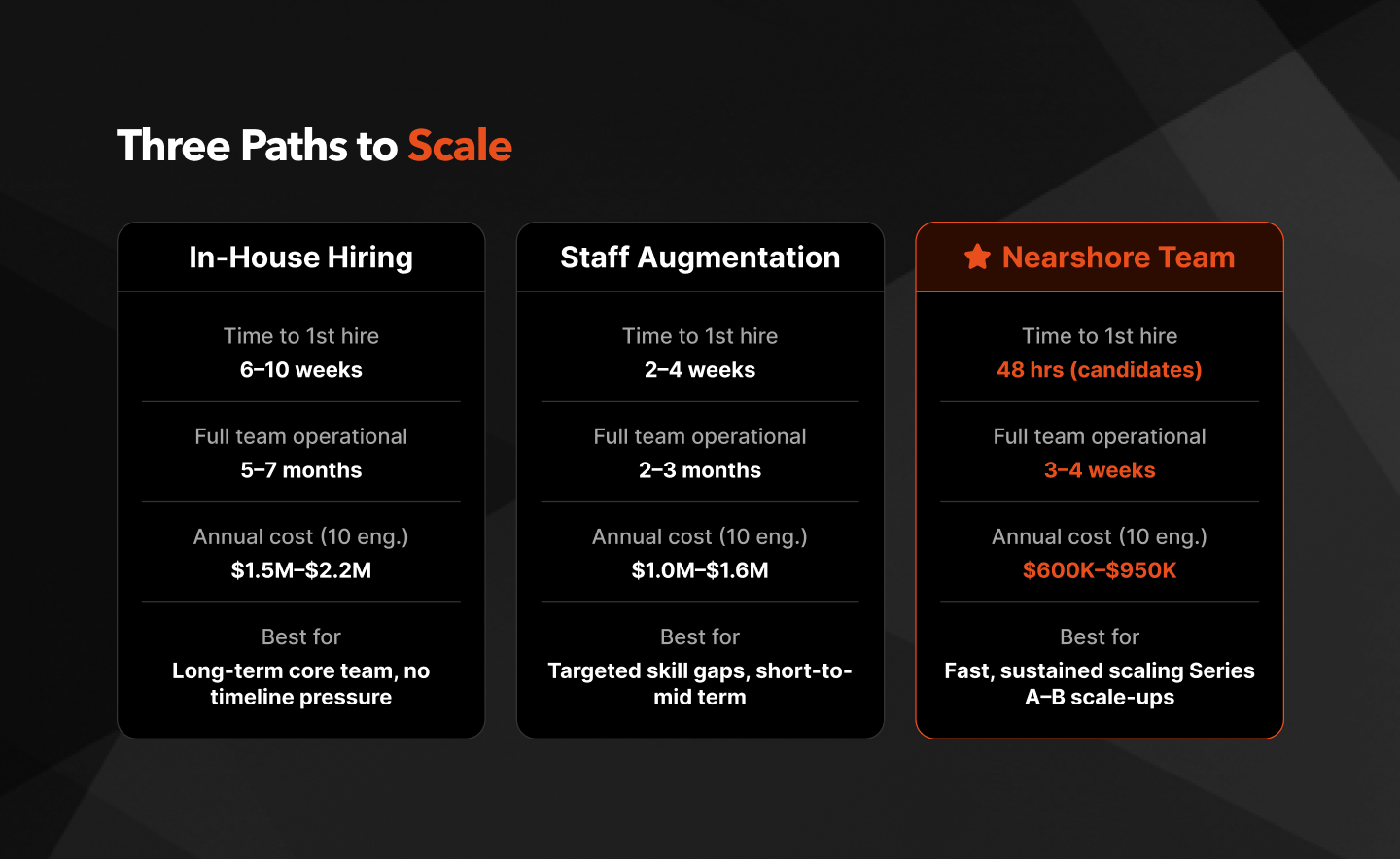
| Model | Time to 1st hire | Full team operational | Annual cost (10 sr. eng.) | Best for |
| In-house hiring | 6–10 weeks | 5–7 months | $1.5M – $2.2M | Long-term core team; no timeline pressure |
| Staff augmentation | 2–4 weeks | 2–3 months | $1.0M – $1.6M | Targeted skill gaps; short-to-mid term |
| ★Nearshore Dedicated Team | 48 hours (candidates) | 3–4 weeks | $600K – $950K | Fast scaling with sustained engagement; Series A–B scale-ups |
Rates assume LATAM nearshore (a dedicated development team in Colombia, Mexico, Argentina) with senior-level engineers. Eastern Europe rates: $65–$110/hr blended. For a 10-engineer scaling scenario: in-house hiring takes 6-10 weeks to first hire and 5-7 months for a full operational team at $1.5M-$2.2M annually; staff augmentation takes 2-4 weeks to first hire and 2-3 months to full team at $1.0M-$1.6M annually; nearshore software development delivers first candidates in 48 hours and a full operational team in 3-4 weeks at $600K-$950K annually.
When each model breaks down
All the models listed here can fail if the situation is not right, including the ones we offer. Here is how each can run into problems.
In-house hiring does not work well if you need someone in under three months. Finding senior engineers usually takes 6-10 weeks, then another month before they can start. This means you could miss a Q2 deadline before making your first offer.
In-house hiring also fails when you need more senior talent than your local market can provide. For example, if only 30 staff-level backend engineers are in your area and five companies try to hire them, you end up in a bidding war for people not even looking for new jobs.
Staff augmentation stops working well after about a year. If augmented engineers stay that long, they inevitably become part of your team. They know your projects, own parts of the code, and join all your meetings. But since they are not permanent, there is no plan to keep them. If they leave, their knowledge goes with them without notice or handover.
A nearshore dedicated team doesn’t work if you need everyone working together in real time and the same time zone. For example, a US East Coast team needing people available from 9am to 6pm EST will notice the time difference daily.
This model also fails if your company culture relies on everyone being in the same place. Remote engineering teams cannot replace a setup that depends on hallway conversations to get work done.
How to scale without slowing down delivery: Onboarding framework
Adding 5 new hires can slow down your sprint velocity. Each new hire usually takes up 15-20% of a tech lead’s time, as mentioned earlier.
However, this cost can change depending on your approach. If you treat engineering team onboarding as a structured process with distinct steps, set aside enough capacity, and determine weekly output goals, you can plan for ramp-up costs ahead of time.
The parallel ramp-up protocol: Onboarding 5–10 engineers without sprint disruption
| Week | New engineers | Current team | Expectations |
| Week 1 | Environment setup, codebase orientation, architecture walkthrough | Tech lead: 20% time on onboarding. No sprint tasks assigned to new hires. | 0% delivery contribution. Investment week. |
| Week 2 | First isolated tasks (bug fixes, test coverage, documentation) | Tech lead: 15% time. Code review bandwidth reserved. | 20–30% contribution. Ramp begins. |
| Week 3–4 | First feature-level tasks with explicit scope boundaries | Tech lead: 10% time. Async review norms established. | 50–60% contribution. Velocity recovering. |
| Week 5–6 | Full sprint participation. Ownership of defined modules. | Standard review cadence. Onboarding officially complete. | 80–90% contribution. Team at full velocity. |
When you bring on more than three new engineers per sprint without setting aside extra time for your tech leads, your team’s velocity will slow for 4-6 weeks rather than increase as expected. Try hiring in smaller groups of 2-3 per sprint to make sure you always have enough onboarding support.
Pre-onboarding checklist: Before the first new engineer starts
Successful onboarding starts before the new hire’s first day. Go through this list before you scale the software development team, and if you have fewer than 6 out of 8 items ready, postpone the start date by two weeks to finish preparing. Taking this time upfront is much better than having a new team join in a disorganized environment.
- Architecture Decision Records (ADRs) are well-documented and easy for everyone to find.
- A code ownership map exists, and every module has a clearly named owner.
- Setting up the local environment takes less than two hours, thanks to an automated setup script.
- Every new hire is matched with an onboarding buddy. This buddy is a senior engineer, not the tech lead.
- Tasks for the first two weeks are clearly defined before the new hire starts.
- Communication norms are documented. These include async-first practices, response time expectations, and the format for standups.
- An access provisioning checklist that covers repositories, CI/CD, monitoring tools, and the staging environment is in place.
- Sprint planning reserves 15-20% of the tech lead’s time for support and guidance.
Squad structure: The architecture that prevents coordination collapse
The engineering team’s structure determines whether your other scaling efforts pay off. Two notable examples here:
- Spotify scaled its engineering team by grouping developers into small, autonomous squads, each owning a distinct product area end-to-end, from planning through production.
- Team Topologies later defined two main team types. Stream-aligned teams deliver product features straight to customers, while platform teams create self-service tools to make things easier for those teams.
How you organize squads will affect your company’s ability to scale because it shapes how well teams work together as you grow.
When your engineering team grows beyond 12 people, it will naturally break into squads. The key is to decide if you want to guide that split or just let it happen on its own.
When to introduce squad topology
Squad size and the warning signs below tell you if you’ve already waited too long.
| Team size | Recommended structure | Warning signs it’s late |
| < 10 people | Single team, shared backlog, one standup | Not applicable yet |
| 10–15 people | Introduce 2 informal squads with named leads, no formal reorg required | Every engineer is on every decision thread |
| 15–20 people | Formal squad definition with product alignment and explicit API contracts between squads | Squads are blocked on each other weekly |
| 20–25 people | Full team topology: stream-aligned squads + platform team + enablement function | Platform work is absorbed by product squads |
Teams under 10 people run as a single team with a shared backlog. At 10-15 people, two informal squads with named leads should emerge. The warning sign of waiting too long is when every engineer is on every decision thread.
At 15-20 people, squads need formal definition with explicit API contracts. The warning sign is squads blocking each other weekly.
At 20-25 people, full team topology is needed: stream-aligned squads, a platform team, and an enablement function. The warning sign is platform work being absorbed by product squads.
5 common scaling mistakes (and how to avoid them)
The five most common engineering scaling mistakes are: hiring before architecture is documented, adding headcount without squad structure, onboarding everyone simultaneously, promoting engineers to leads without management training, and choosing a hiring model based on cost alone rather than timeline.
None of the mistakes below are dead ends. They’re hurdles, each with a straightforward fix.
| Mistake | Root cause | How to prevent |
| Hiring before architecture is documented | Speed pressure overrides process | Freeze architecture docs as a pre-hiring gate |
| Adding headcount without squad structure | Org design treated as secondary to hiring | Define squad boundaries at 10 people, not 20 |
| Onboarding everyone simultaneously | No ramp-up sequencing plan | Cohort hires in groups of 2–3 per sprint |
| Promoting engineers to leads without management training | Fastest path promoted, not best-fit path | Separate IC and management tracks at 15+ people |
| Choosing a hiring model based on cost alone | CFO drives decision without CTO input on timeline | Timeline constraint should determine model, not budget alone |
How nCube helps scale-ups scale engineering teams
Scaling quickly and scaling smoothly rarely happen together. Most vendors make you pick one or the other.
nCube solves this problem by assembling dedicated nearshore engineering teams and R&D centers tailored to your needs.
Speed:
- You’ll see your first candidates in just 48 hours.
- Your full team will be up and running in 3-4 weeks.
- We cover every role you need, including backend, cloud, data, QA, and DevOps.
- Our process is fast enough to meet a 90-day deadline, and you won’t have to deal with the stress of hurried in-house hiring.
Continuity:
- On average, our engineers stay with us for 3+ years.
- The team you begin the year with will be the same team delivering your roadmap by the end of the year.
- You won’t have to worry about constant turnover or having to onboard new people each quarter.
- We’ve proven our approach with companies like CrossEngage, Life360, Encore Capital, and Flightright.
FAQ
Frequently asked questions you may have before our call
How long does it take to scale an engineering team from 8 to 25 people?
Building a 25-person engineering team in-house takes 5 to 7 months. With a nearshore dedicated team, you can do this in just 3 to 4 weeks and see initial candidates within 48 hours. This makes it possible to meet a 90-day deadline that in-house hiring cannot meet.
What is the right team structure for a 15-person engineering team?
Set up formal squads that match your product areas, with clear API agreements between them. The informal setup that worked at 10 people stops working at 15: cross-team dependencies start slowing releases down. If your squads are blocked on each other every week just to ship features, you’re already behind.
How do you onboard multiple engineers at the same time without losing velocity?
Limit onboarding to 2 or 3 new engineers per sprint and make sure to set aside tech lead time during sprint planning before they start. Plan for about 20% of their time in the first week, then reduce to 10% by weeks 3 and 4. If you bring on more than three engineers at once without this extra support, the whole team’s progress will slow down for 4 to 6 weeks, instead of having a smoother ramp-up.
What is the difference between staff augmentation and a dedicated development team?
Staff augmentation means bringing in individual contractors to cover specific skill gaps within your team. This approach is useful for short- or medium-term increases in workload, but your own managers still handle onboarding, assigning tasks, and coordination. In contrast, a dedicated team is a group of specialists (such as backend, cloud, QA, and DevOps experts) who are assembled and ready in about 3-4 weeks to fully manage a product area. Staff augmentation is not ideal for projects lasting more than a year if you treat contractors as permanent staff but lack the systems to keep them engaged and to prevent sudden departures or knowledge loss.
How much does it cost to scale an engineering team by 10 people?
Hiring in-house usually costs between $1.5 million and $2.2 million per year, including salary, taxes, equity, and benefits. Staff augmentation costs less, ranging from $1.0 million to $1.6 million per year, depending on tech stack. A nearshore dedicated team for a full cross-functional group in similar time zones costs about $600,000 to $950,000 per year. Teams in Latin America are typically at the lower end of this range. Eastern European teams often charge between $65 and $110 per hour on average.
When should a startup move from staff augmentation to a dedicated team model?
You should consider switching around the 12-month mark, or even earlier if your augmented engineers are already acting like core team members. If they hold important knowledge, manage key modules, and lead your daily standups, it may be time to move on. After this point, staff augmentation can become risky. It does not offer the support or career growth needed to keep your knowledge safe. If these people leave suddenly, they can take months of valuable context with them, and there may be no proper handover.
What is nearshore engineering and how does it differ from offshore?
Nearshore engineering means your development team is based in a nearby region with 4-8 working hours in common. For US companies, this usually means Latin America, like Mexico, Colombia, or Argentina. For Western European firms, it often means Eastern Europe. Offshore teams, on the other hand, are in faraway time zones with little or no real-time overlap, most often in South or Southeast Asia. The main difference is not just location, but how quickly teams can work together. Nearshore teams can hold daily meetings, collaborate in real time, and review code the same day. Offshore teams have to hand off work across a gap of 10 hours or more, which is fine for simple, well-defined tasks but can slow down complex projects that require a lot of back-and-forth.