How to choose a nearshore engineering partner: The evaluation framework CTOs actually use



Great, another guide on picking a nearshore software development partner. No vendor writes a selection guide against its own interest, right?
Wait, don’t close this just yet. You caught us. Our first draft was a checklist of everything we already excel at: senior engineers, agile workflows, your time zone. Generic through and through.
So, we took a different path, and here’s what we came up with:
- 9 criteria, each with a number and a way to verify it on a discovery call.
- A scorecard for every vendor on your shortlist.
- 7 red flags that separate a real partner from a staff-leasing shop.
- The questions that get past rehearsed answers.
Everything below can be verified without taking a word for it. Use it on every vendor you consider. Starting with us, if you like.
Why most nearshore partner evaluations don’t work
If you’re like most tech leaders, you do your homework. You run the calls, sit through the pilots, take the references, and still might end up with the wrong partner.
The problem isn’t the effort: all standard checks are created by vendors. They are built to be passed.
Let’s go over them one by one.
- Reference calls. The vendor connects you with a few past or current clients so you can hear how the engagement went. It sounds like proof. But no surprise, vendors choose who you talk to. You never hear from the client who left after eight months. You rarely get the full picture.
- Pilots. A short paid project to show you how the vendor works before you commit. In practice, you see the vendor’s best side: top engineers, leadership paying extra attention, and a scope designed to succeed. After you sign, the A-team moves on to the next prospect. You then meet the regular operating model for the first time.
- Discovery calls. The first real conversation where you’re supposed to get past the marketing and see how the vendor actually works. Instead, when you ask about process or communication, you get a rehearsed answer that tells you nothing new beyond the pitch deck.
So how do you make evaluations work? Double down on diligence? Run a longer pilot? Ask for more references? None of this helps; it’s more of the same.
Use the framework below instead. Every question in it comes with a number or a document you can check. It cuts through the sales charm and shows you the vendor you actually want to work with.
How to evaluate a nearshore engineering partner: 9 criteria with benchmarks
Most people start by looking at real-life cases, such as portfolios, case studies, and logos of famous brands. These can look impressive but are also the easiest to exaggerate. Whereas details like retention, operational ownership, and contract terms are much harder to embellish.
1. Engineer retention and tenure
Why it matters: Will the team you get in Q1 still be your team in Q4? When an engineer leaves, it usually takes their replacement 2-4 months to get fully up to speed. Some product knowledge is lost forever. If your team keeps changing, you end up paying this cost again and again.
How to verify: Ask how long, on average, engineers have stayed on client teams over the past two years. If the partner tracks this, they should be able to give you the numbers quickly.
Benchmark: An average of 2.5 years is acceptable. If engineers stay for 3.5 years or more, it shows that the partner is good at keeping talent. That kind of retention is not accidental.
2. Time to first candidate
Why it matters: This helps you see if your partner has a reliable HR team and good processes. Without it, your project could be delayed, sometimes by weeks or even months.
How to verify: Ask for the SLA that covers how quickly they deliver the first candidate and build a full team. You should also request a real client example with exact dates.
Benchmark: You can expect to see the first candidates within 48 to 72 hours. A full team of 5 to 10 engineers should be ready to start in 3 to 4 weeks.
3. Operational coverage model
Why it matters: A vendor only supplies staff, but a partner does much more. They manage HR, talent retention, legal aspects, IT infrastructure, and on-the-ground support for your dedicated development team.
How to verify: Ask, “Do you take care of HR, payroll, legal setup, office management, and keeping engineers on the team for us?” If they say yes, ask them to explain how they handle each part, and pay attention to any conditions they mention.
Benchmark: The partner should take care of all operations, usually with a team focused on your needs, like an R&D center. If they say it depends or want you to handle some tasks, take it as a warning sign.
4. Regional expertise and talent availability
Why it matters: Some companies say they work worldwide, but they might not have a real network in your target area. They could be finding engineers the same way you would, by posting on job boards. In that case, you’re paying for recruiting reach that isn’t actually there.
How to verify: Ask how many engineers they have in the location where you want to build your team. Also, have them walk you through their process for finding, checking, and onboarding talent.
Benchmark: Look for at least 100,000 verified engineers in your region. Make sure the company handles the entire recruiting process internally. Stay away from companies that only gather resumes from job boards.
5. Seniority distribution in client teams
Why it matters: Some vendors pick who works on your project without bringing you into the loop. You expect senior (or at least mid-level) developers but end up with overpriced juniors. One senior engineer usually fixes their work to make everything look good. In the end, you receive invoices for a team of five, but the expertise of one.
How to verify: Ask for a breakdown of seniority in a typical client team. Then ask to see an example team built for a client similar to you, including roles, seniority, and tenure with the company.
Benchmark: For teams built for scale-ups, make sure at least 60% are senior-level or above. Any team of five or more should have a tech lead or engineering manager.
6. Time zone alignment and real-time communication
Why it matters: When a company says, “We work in your time zone,” it sounds promising. However, this might mean anything between a full workday overlap or just 1-2 shared hours, depending on where the team is based. Ask for the exact number of overlapping hours and ensure it aligns with your workflow needs.
How to verify: Don’t accept vague answers. For example, say: “If our team works from 9am to 6pm CET, what is the guaranteed overlap?” If it’s less than four hours, your workflow may suffer.
Benchmark: Aim for 4-6 hours of daily overlap. For clients in the EU, teams in Eastern Europe can provide this without anyone needing to work unusual hours.
7. Proven client continuity
Why it matters: When a partner keeps clients for a long time, it shows they build real relationships. If clients leave often, it could mean there are problems, like clients choosing to leave or the partner always looking for new deals. In either case, your business could be at risk.
How to verify: Ask about the average length of their client relationships. You can also request 2-3 references from clients who have worked with them for more than two years.
Benchmark: Look for an average client engagement of at least 18 months. If they have clients who have stayed for 3-5 years or more, that is a very positive sign.
8. Transparent failure cases
Why it matters: Every vendor has failed at some point. One claiming otherwise isn’t flawless, just quiet about it. The ones who talk openly about a real mistake, and what they changed after, will be just as straight with you if your project hits a wall.
How to verify: Ask them to describe a project that didn’t go as planned and how they handled it. Listen to how they discuss challenges, not just successes. Be cautious if they have no examples or always make themselves look good.
Benchmark: They should cover the problem, what was done about it, and how things turned out. Make sure the cause is clear and comes from their own actions. For example, saying “we staffed the wrong team for their domain” works, but blaming the client for changing the scope doesn’t.
9. Contract structure and exit clarity
Why it matters: Clients stay with a vendor for one of two reasons: the teams they build are solid, or the exit is expensive. Check for hidden costs, such as early-termination penalties, transition charges, or buyout clauses for hiring an engineer as well as unclear exit rules.
How to verify: You may be thinking, “Surely this is all standard,” but it pays to ask: “What’s the notice period if you want out, and are there any penalties lurking in the shadows?” Always get a look at the standard contract before you even think about signing.
Benchmark: The ideal is a 30-to-60-day notice period with no penalty clauses. If the notice period is longer or there’s an early-termination fee, treat it as a clear warning sign.
Nearshore partner evaluation scorecard
These nine criteria are effective only if you use them consistently for every vendor. The scorecard below helps with this. Rate each area from 1 to 3 for each nearshore development company: 1 is below the benchmark or unclear, 2 meets the benchmark, and 3 exceeds it with proof. The highest possible score is 27. If a vendor scores below 15, don’t move forward. A score of 20 or more means they’re a strong candidate.
| Criterion | Weight | Vendor A | Vendor B | Vendor C |
| Engineer tenure (avg years) | ×3 | |||
| Time to first candidate | ×3 | |||
| Operational coverage model | ×3 | |||
| Regional talent pool depth | ×2 | |||
| Seniority distribution | ×3 | |||
| Time zone overlap (hours/day) | ×2 | |||
| Client engagement length (avg) | ×3 | |||
| Transparent failure case | ×2 | |||
| Contract / exit clarity | ×3 | |||
| TOTAL SCORE | /27 |
Rate each criterion 1 to 3 for every vendor on your shortlist: 1 means below benchmark or unverified on the call; 2 means meets the benchmark; 3 means exceeds it with documentation or a reference to back it up. The highest possible score is 27. Below 15: do not proceed. 20 or above: strong candidate.
Keep two rules in mind when you fill this out.
First, the marked criteria (×3) are must-haves. If any of them scores below 2, walk away, no matter how good the total looks. A vendor of staff augmentation might shine on talent pool or time zones, but none of that compensates for a team that keeps rotating or a contract you can’t leave.
Second, give 2 or 3 points only when a vendor provides documents or references. Unproven reassurances on a call stay at 1 until you verify them.
The table shows three vendors. If you have more on your shortlist, just add more columns as needed.
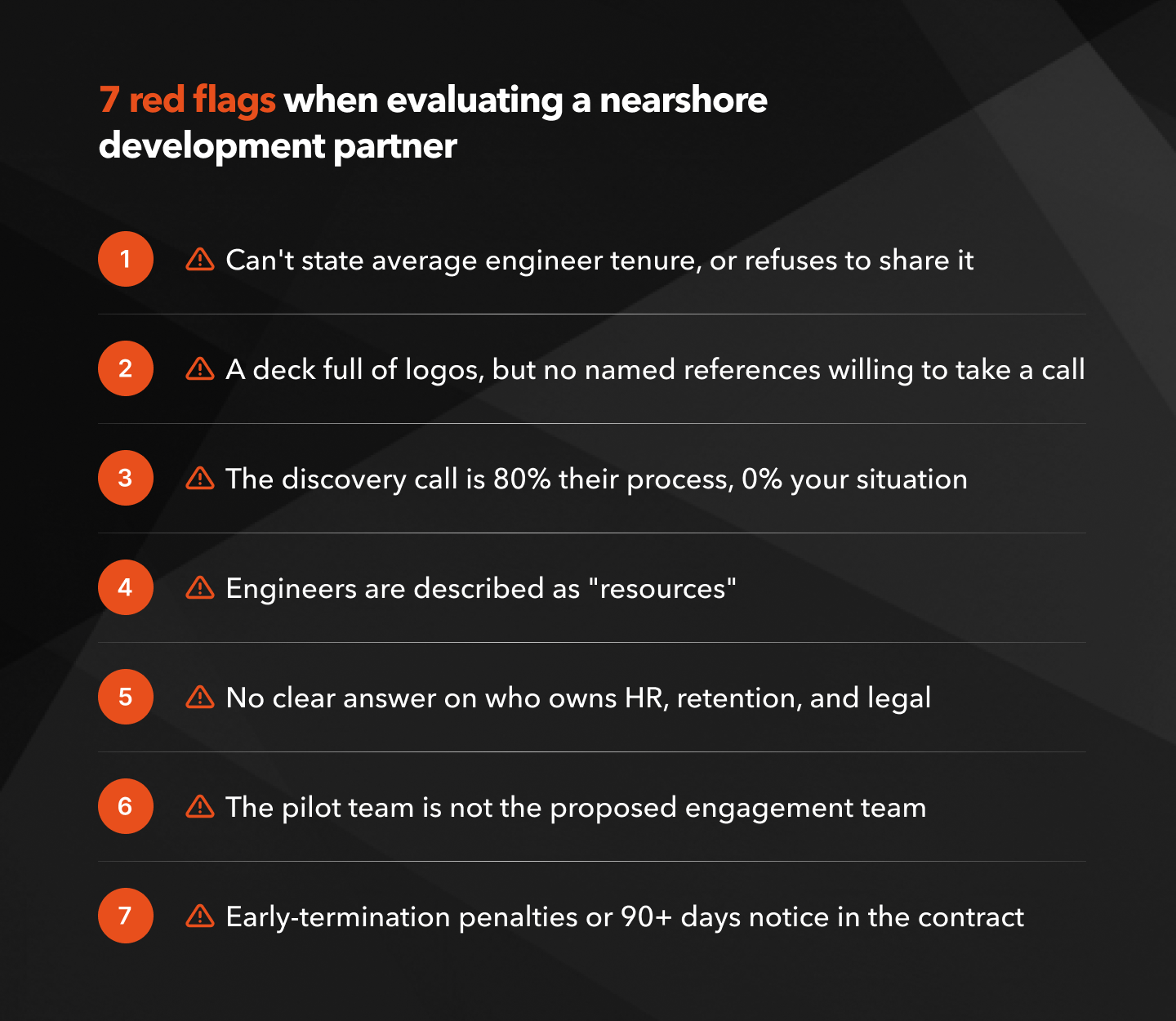
7 red flags that signal a vendor, not a partner
You won’t find these red flags in the presentation. If you spot them early, you might just lose an hour on a call. If you miss them until month 4, you could end up looking for a new team.
| # | Red flag | Why it matters |
| 1. | Cannot state average engineer tenure or refuses to share it. | Retention is the single biggest predictor of team continuity. If they don’t track it, they don’t manage it. |
| 2 | Presents a deck full of logos but no named references willing to take a call. | Any vendor can add logos. A partner has clients who will spend 30 minutes on a call about them. |
| 3. | The discovery call is 80% about their process and 0% about your situation. | A vendor sells a standard offering. A partner diagnoses your problem first. |
| 4. | Engineers are described as “resources” in their communications. | Language reveals the model. Resources are replaceable; engineers carry context, ownership, and institutional knowledge. |
| 5. | No clear answer on who owns HR, retention, and legal for the team. | If they can’t answer this, you will own it by default. You don’t want to. |
| 6. | The pilot team is not the proposed engagement team. | Pilot-and-switch is the oldest trick in the vendor playbook. Confirm that the people you’re piloting with are the people you’ll work with. |
| 7. | The contract carries early-termination penalties or requires 90+ days’ notice. | Confidence in quality means easy exits. Lock-in clauses hedge against your leaving, and that tells you what the vendor expects. |
Questions to ask on the discovery call
Asking the right questions early on is the key to choosing the right software development company. If you stick to generic questions, you’ll only get practiced answers. The questions below are built to get a straight answer.
We also included what a strong answer should be, so you can compare nearshore development companies in a way that you can clearly explain your choices to your board.
Retention and team stability
| Question | What a strong answer looks like |
| What is your average engineer tenure across active client teams? | A specific number, 2.5+ years, not “it depends on the client.” |
| What happens if a key engineer on our team decides to leave? | A defined replacement process with a timeline SLA and a knowledge transfer protocol. |
| How do you handle engineer performance issues within a client team? | A clear escalation path with joint accountability, not “that’s between you and the engineer.” |
Operations and ownership
| Question | What a strong answer looks like |
| Who is responsible for HR, payroll, the legal entity, and office management for the team? | “We handle all of it.” Full operational ownership, no ambiguity. |
| What do the first 30 days of an engagement look like operationally? | A specific timeline: onboarding steps, first sprint setup, communication cadence, escalation paths. |
| How do you handle compliance and data security for a client in a regulated industry? | Demonstrated experience, not “we can figure it out.” |
Track record and transparency
| Question | What a strong answer looks like |
| Can you share an engagement that didn’t go as planned and how you addressed it? | An honest, specific answer. A polished non-answer is a red flag. |
| What is your average client engagement length? | 18+ months. A short average means high churn, and high churn means a transactional model. |
| Can we speak with a reference client whose engagement is similar to ours? | “Yes, here are three.” Not “let me check with our team first.” |
Go through all nine questions. If the vendor gives clear answers to each one, keep them on your list. If two or three answers seem weak, it’s fine to move on. You’ve only spent one call.
Why nCube is your nearshore partner, not just a vendor
Engineer tenure
On average, nCube engineers stay with client teams for 3.5 years, which is a year longer than the industry standard. This loyalty is no accident. nCube supports its engineers with retention programs, clear career paths, and its own offices in Ukraine and Poland, rather than using freelancers. So, the team you meet at the start is the same team that delivers your project at the end.
Time to first candidate and full team
After you sign the brief, nCube can show you your first candidates within 48 hours, thanks to a network of over 200,000 engineers in Eastern Europe and LATAM. Building a full team of 5 to 10 engineers usually takes only 2 to 4 weeks. No matter how you look at it, these numbers raise the standard.
Operational ownership
nCube manages HR, legal, payroll, IT infrastructure, and office support for every team it builds. You can focus on your roadmap while nCube takes care of everything else.
FAQ
Frequently asked questions you may have before our call
What is the difference between a nearshore vendor and a nearshore partner?
A vendor provides engineers but leaves everything else up to you. A partner, on the other hand, takes care of the team’s HR, retention, legal compliance, and infrastructure. The easiest way to tell the difference is to ask who manages payroll, the legal entity, and keeping engineers on board. Vendors usually have conditions, while partners simply say, “we do.”
How long does it take to evaluate a nearshore software development company?
If you use a structured framework, it usually takes about two weeks to evaluate a shortlist. This includes one discovery call with each vendor, a few document requests, and two or three reference calls for the finalists. Without a framework, the process can take months, since you have to test every claim through a pilot instead of just asking questions. The nine criteria above are designed to help you speed up the process.
What is a good average engineer tenure for a nearshore company?
An average of 2.5 years is acceptable. 3.5 years or more shows a real retention model behind the teams. A company that can’t state its average tenure, or won’t, most likely doesn’t track it, and retention is the strongest predictor of whether your team still exists in a year. Ask for the number with a breakdown by seniority grade.
What questions should I ask a nearshore development company on the first call?
Start with these five questions: What is the average tenure of their engineers? How quickly do they provide the first candidates? Who handles HR and legal matters for your team? How long do clients usually work with them? Can they share an example of a project that did not go as planned? A reliable partner will answer each one clearly and with details. You can find the complete list and examples of good answers in the discovery call section above.
How do I check references for a nearshore software development partner?
Don’t rely only on the references the vendor offers; those are chosen for you. Ask for clients whose engagements passed the 2-year mark and whose team size matches yours. Then ask those references about engineer turnover, what went wrong during the engagement, and how the partner handled it. A partner confident in its record will connect you without hesitation.
What should be included in a nearshore development contract?
Focus on four main things: make sure all work comes with full IP assignment, set a 30-60 day notice period without early-termination fees, outline how and when to replace engineers who leave, and clarify who handles HR and legal matters. Watch out for lock-in clauses or notice periods over 90 days, since these are often warning signs.
How is nearshore different from offshore software development?
The main difference is the time zone overlap. A nearshore team is usually 1-3 hours away from your working hours, giving you 4-6 hours of real-time collaboration. With offshore teams, most work happens asynchronously, as they are 6-12 hours away from your location. For companies in the EU, Eastern Europe is considered nearshore. For US companies, LATAM fills that role. Staff augmentation can work with both models, but if your process depends on same-day communication, you need the overlap nearshore provides.