Dedicated Software Development Team Pricing: Real 2026 Rates



Key takeaways:
A dedicated development team runs about $4,000–$28,000 per developer a month, depending on region, seniority, and roles.
Region drives dedicated software development team pricing most: ~$100–$175/hr in North America, $45–$80 in Eastern Europe, $35–$65 in LatAm, $25–$50 in Asia
Three factors move a quote most: region, seniority mix, and the vendor’s model and margin.
LATAM is usually the best value for US companies: real-time overlap, and no costly async delays eating the offshore saving.
Add 20–30% to any quote for onboarding, tooling, margin, and your own team’s coordination time.
If you’ve landed here, your roadmap needs more hands than it did last quarter. More features, more backlog, and your team is already under intense pressure. So, you decide to bring in a dedicated development team to ship on time.
Then you start reviewing rate cards, and the quotes are all over the map: $12,000 a month from one vendor, $60,000 from another. Dedicated software development team pricing swings this wide from vendor to vendor, so which number do you build a budget around?
The cost to hire a dedicated remote developers team varies this much because many factors are at play, from location and team experience to vendor pricing models and extra fees.
Companies like Life360, Flightright, and CrossEngage have scaled their engineering this way with nCube, and this guide breaks down the same pricing decisions behind those teams. You’ll learn about the five pricing models, see the current 2026 rates by region and role, find out what affects a quote, and get a simple guide to building your own budget.
Want a number specific to your project?
Dedicated software development team pricing models
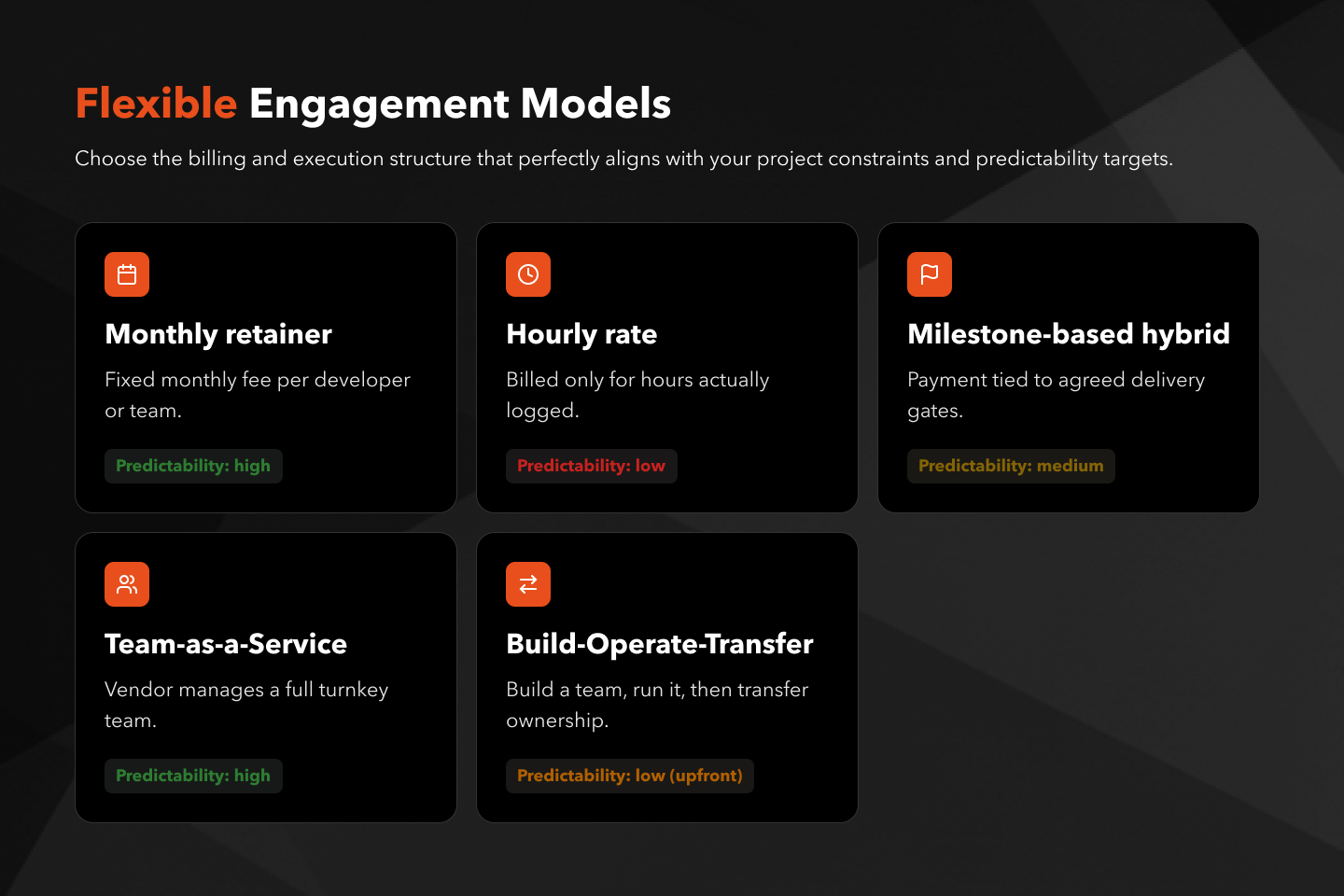
Two vendors might build similar teams but use different ways to bill you. Always ask each vendor how they structure dedicated software development team pricing before evaluating rates. Most dedicated teams charge a monthly retainer, but you may also explore hourly, milestone-based, and other models.
The billing model matters as much as the rate, because it determines how predictable your costs are and the risk of going over your budget.
Monthly retainer
You pay a set, recurring monthly fee for a developer or a full team that works exclusively on your product. This is the standard approach for dedicated projects, and its main benefit is predictability.
- How it works: The flat monthly fee covers salary, taxes, benefits, equipment, and the vendor’s margin.
- Cost advantage: This model usually offers better value than hourly billing. Because the team’s time is fully booked, vendors can often lower the effective rate by 15-25%. As the team accumulates product knowledge, their work tends to become faster and more consistent.
- The trade-off: The main trade-off is that you pay for the team’s full capacity, even if you don’t use all of it. If work slows down or a feature is paused, you still pay the full amount. The good news is that most dedicated setups let you adjust the team size as your plans change, so you are not stuck with the cost that outlived its usefulness.
- Watch out for: Scope creep and management boundaries. The vendor takes care of HR and keeping the team together, but you are still responsible for running the sprints. Make sure to set clear priorities and plan for the time you’ll need to guide the team.
Hourly rate
You pay only for the hours worked, using rates agreed for each role. This approach gives you flexibility to change direction as needed, but you lose some budget predictability.
- How it works: Each role carries a set hourly bill rate, which bundles the developer’s pay and the vendor’s markup, usually 35–50% over base cost. A light month costs less, a heavy month costs more, and you pay for exactly the hours used.
- Best for: When your workload changes from month to month and you don’t have enough tasks to fill a permanent developer’s full schedule. If a monthly retainer would leave you paying for unused time, hourly billing lets you pay only for the work you need.
- The trade-off: Your invoice might go up if unexpected issues or changes come up, sometimes without warning.
- Watch out for: Before you agree to hourly billing, ask for a maximum limit and weekly updates on hours worked. This way, you keep things flexible but still under control, which helps lower your financial risk.
Milestone-based hybrid
You only pay when your dedicated team reaches each agreed milestone, instead of paying a set monthly fee. This way, you pay for results as they happen.
- How it works: The project is divided into phases, each with a defined deliverable and payment. After you approve a phase, you release the payment. If the deliverable does not meet expectations, you may withhold payment until it is corrected.
- Best for: You have a clear project scope and want to pay as each phase is finished. You pay for results, not for time or a full project upfront like with fixed-price contracts or retainers.
- The trade-off: You need to review and approve each milestone before the project moves forward, which takes more of your time compared to a retainer. It can also be riskier if you are working with a new vendor, since a lack of experience can lead to disagreements and delays.
- Watch out for: Vague milestones. Try not to use general phrases like “Phase 1 complete,” since these can lead to disagreements. Make sure each milestone is a clear deliverable with specific acceptance criteria and a review deadline. Disputes can add extra time and costs.
Team-as-a-Service (TaaS)
The vendor puts together the team, manages who is on it, and takes responsibility for delivering results. You just say what you need, and the provider takes care of hiring, contracts, replacements, equipment, and team logistics.
- How it works: You pay a monthly fee for a fully managed team, usually including a project manager. The vendor handles everything from staffing and retention to workspace and payroll. The same team stays with your product over time, so they build up valuable context.
- Best for: Companies that need more capacity but don’t want the hassle of managing a software development unit themselves. This model works well if you prefer to focus on your product and strategy instead of dealing with sprint planning, hiring, and retention.
- The trade-off: Convenience versus visibility. When the vendor handles delivery, you do not see as much of the daily work as you would if you managed the team yourself. This approach also tends to cost more, since you are paying for an extra layer of management.
- Watch out for: Losing sight of the work. If a vendor is in charge of delivery, problems can take longer to notice than if you were more hands-on with the code. To stay up to date, schedule regular demos, use live dashboards, and talk directly with the engineers rather than only speaking with the account manager.
nCube stands out when it comes to the team-as-a-service model. You always have full visibility and direct access to your team. We take care of the logistics, hiring, retention, infrastructure, and payroll. With us, you keep your team, your process, and your success, without having to choose between convenience and visibility like with most TaaS providers.
BOT (Build-Operate-Transfer)
A vendor builds your dedicated team from scratch, manages it as it grows, and eventually hands everything over to you. In the end, you get a fully owned offshore/nearshore development hub with people, workflows, and intellectual property without having to set it up yourself.
- How it works: After the team is built (you pay an initial setup fee), the vendor handles daily operations and delivery for a regular service fee, through a transition period that usually lasts 1-3 years. Then the vendor hands over the team, systems, and intellectual property to you, with a final buy-out fee at handover, often based on the number of engineers.
- Best for: Companies looking to build a large engineering hub they want to fully own, not just staff a single project. This approach works best if you have a long-term plan, since the benefits appear over several years.
- The trade-off: You put money in before you see anything back. The gains come later, on the far side of the handover, when the vendor’s markup falls away.
- Watch out for: The handover, usually the hardest part of any build-operate-transfer deal. Nail down the exit conditions, IP transfer provisions, retention terms, and buy-out formula in advance, so the switch goes smoothly, and no costs catch you off guard.
Pricing models comparison
Now that you’ve looked at all five models, here’s a side-by-side comparison to help you choose the right one for your project before discussing prices.
| Pricing model | Cost predictability | Control level | Best project type | Watch out for |
| Monthly retainer | High | High | Ongoing product development | Scope creep without clear sprint goals |
| Hourly rate | Low | High | Variable or short-term work | Budget overruns if hours aren’t capped |
| Milestone-based hybrid | Medium | Medium | Time-boxed deliverables | Disputes over milestone completion criteria |
| Team-as-a-Service (TaaS) | High | Low–Medium | Turnkey delivery | Less visibility into day-to-day execution |
| BOT (Build-Operate-Transfer) | Low (upfront) | High (long-term) | Long-term team ownership | High setup cost, complex transition phase |
Dedicated development team cost by region: 2026 rates
Location is the single biggest driver of dedicated software development team pricing.
A senior US software developer makes about $64 an hour in base pay, with total compensation between $88,000 and $180,000 a year, according to Payscale. However, base pay is just one part of the expense. When you include benefits, payroll taxes, equity, recruiting, and tools, the total cost for one in-house engineer is usually between $189,000 and $274,000.
In contrast, hiring a dedicated nearshore engineer with similar skills can cost 40 to 65% less. This is mostly because the vendor includes benefits, HR, equipment, and retention in a single rate, and nearshore salaries are generally lower.
Regional rate comparison
| Region | Hourly rate | Monthly cost per dev | Time zone (vs. US ET) | Best for |
| North America | $100–$175 | $16,000–$28,000 | Same / –3 hrs | Compliance-sensitive, proximity-required work |
| Western Europe | $75–$120 | $12,000–$20,000 | +5–6 hrs | EU market-facing products |
| Eastern Europe | $45–$80 | $7,500–$13,000 | +6–9 hrs | Strong engineering depth at mid-range cost |
| Latin America | $35–$65 | $6,000–$11,000 | Same / ±2 hrs | US companies needing real-time collaboration |
| South & Southeast Asia | $25–$50 | $4,000–$8,500 | +9–13 hrs | Maximum cost reduction, async-tolerant teams |
North America (US and Canada)
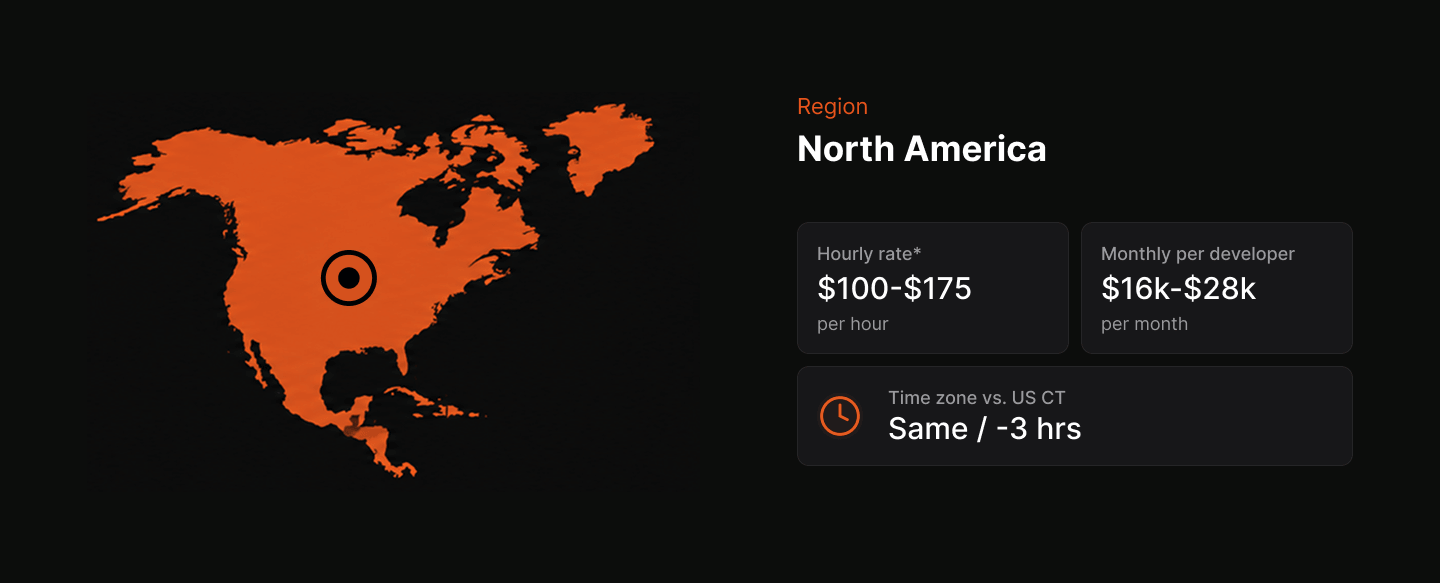
*Indicative 2026 bill rates. Actual cost varies by seniority, tech stack, and specialization
North America sets the standard that other regions are compared to. Rates range from $100 to $175 an hour, or about $16,000 to $28,000 per developer each month, making it the most expensive market.
You pay for local time zone alignment and access to highly specialized engineers, but this talent is rare, costly, and can take time to hire due to strong local demand. Choose this option if you need onshore staff for regulatory reasons, like defense or ITAR projects, or if your early-stage team needs founders and engineers working together in person.
Western Europe
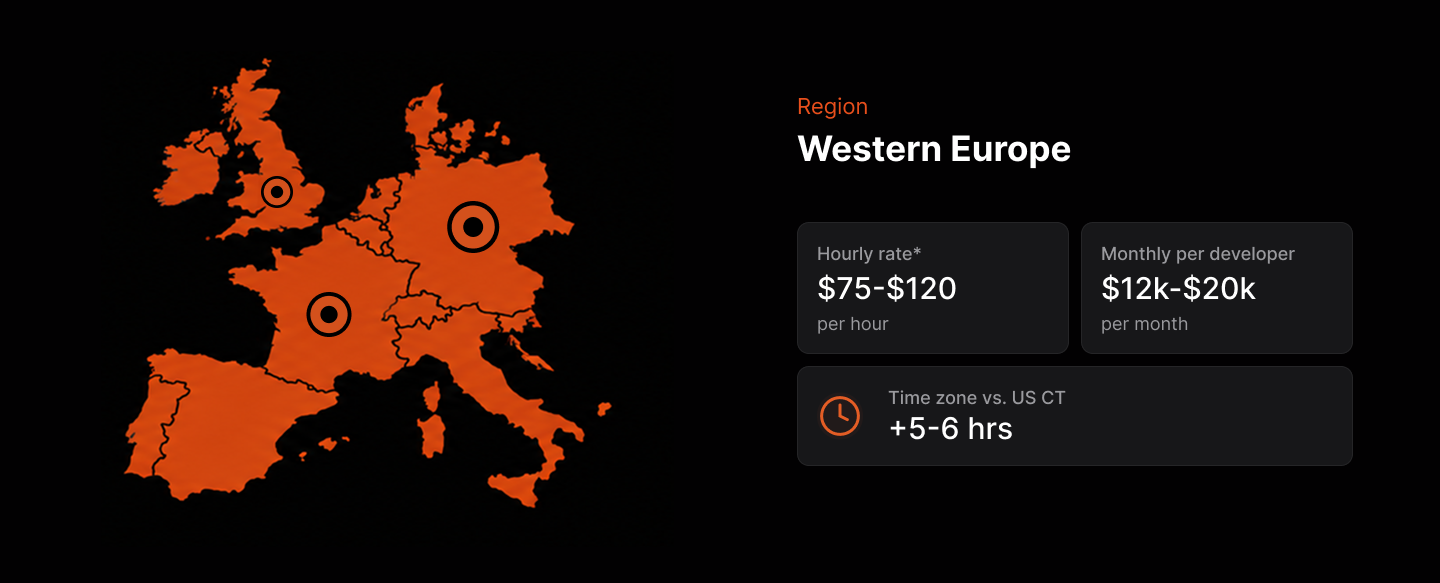
*Indicative 2026 bill rates. Actual cost varies by seniority, tech stack, and specialization
Western Europe has a strong engineering culture, but US companies will see only moderate cost savings here. Hourly rates usually fall between $75 and $120, so you can expect to pay about $12,000 to $20,000 per developer each month. This is less expensive than hiring in North America but still costs more than nearshore options. The region is 5 to 6 hours ahead of US Eastern time, which means you will have some morning overlap, but not a full workday together.
Latin America (LATAM)
LATAM makes it easy for US companies to work together in real time. Rates range from $35 to $65 an hour, or $6,000 to $11,000 per developer each month, which is much lower than in North America.
With just a 1- to 3-hour time difference from US Eastern and Central time, your team can work together for most of the day. Top locations like Brazil, Mexico, Argentina, and Colombia have strong experience in web, mobile, and cloud development. LATAM is a good choice if you want cultural alignment, smooth communication, and skilled talent without paying high local costs.
Eastern Europe (CEE)
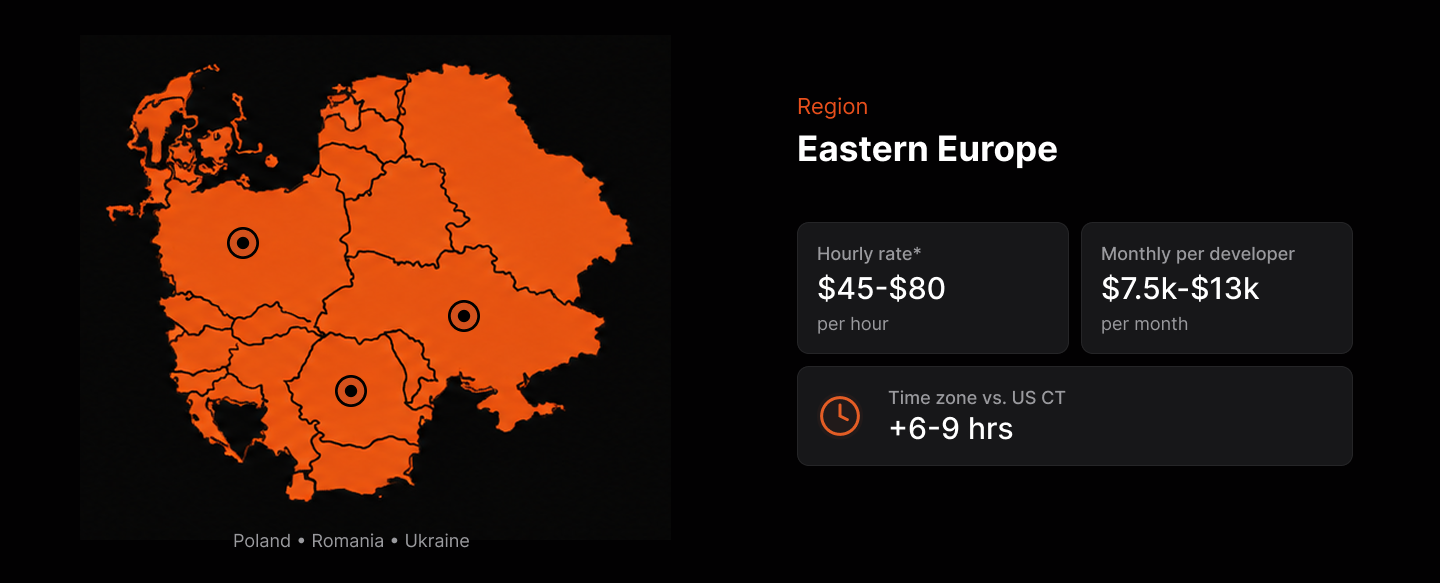
*Indicative 2026 bill rates. Actual cost varies by seniority, tech stack, and specialization
Eastern Europe staff augmentation provides strong technical skills at a moderate price. Rates are $45 to $80 an hour, or about $7,500 to $13,000 per developer each month.
The region is 6 to 9 hours ahead of US Eastern time, so you get 2 to 4 hours of daily overlap for meetings and handoffs. Countries such as Poland, Ukraine, Romania, and Bulgaria have solid experience in AI, machine learning, complex backend systems, and DevOps. This region is a good choice if your project needs deep technical expertise and you can work with a shorter time zone overlap.
South and Southeast Asia
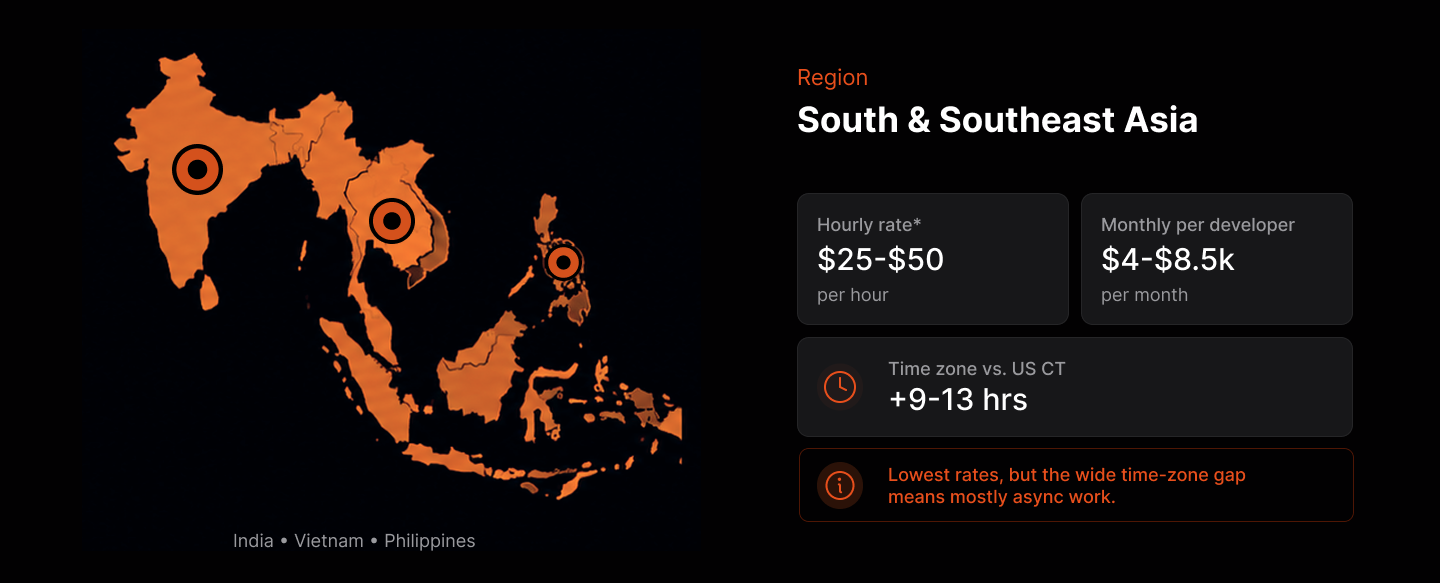
*Indicative 2026 bill rates. Actual cost varies by seniority, tech stack, and specialization
South and Southeast Asia offer the lowest rates and the largest pool of talent. You pay $25 to $50 an hour, or $4,000 to $8,500 per developer each month.
India, Vietnam, and the Philippines have skilled developers for all major tech stacks. With a 9-to-12-hour time difference from US Eastern time, your team will work asynchronously, handing off projects in the morning and evening. This region is a good choice if you want to save money, scale quickly, or maintain legacy systems and can work well with asynchronous workflows.
Dedicated software development team cost by team structure
Looking at just the per-developer rates doesn’t give you the full picture. Dedicated software development team pricing at the team level has to include the whole team, QA, project management, and senior oversight, not only the developers.
Team structure cost by region
| Team structure | Composition | LatAm / Month | Eastern Europe / Month | Asia / Month |
| Small team (MVP) | 2–4 devs + QA | $14,000–$36,000 | $18,000–$46,000 | $10,000–$26,000 |
| Mid-size team | 5–8 engineers + PM | $35,000–$80,000 | $45,000–$100,000 | $24,000–$56,000 |
| Enterprise team | 9+ engineers + architect + PM + QA leads | $80,000–$160,000+ | $100,000–$200,000+ | $55,000–$120,000+ |
Small team (MVP)
A small team of 2 to 4 developers and a part-time QA. Your own tech lead makes architecture decisions, sets priorities, reviews the work, and keeps sprints on track, instead of relying on a vendor project manager.
Such a team is the most efficient way to get started, with far less overhead than a larger unit. While hiring a senior in-house employee can take more than 90 days, a vendor can present candidates within 24-48 hours, so your team can start building while your job posting is still open.
Essentially, your budget goes directly to engineering, not to extra vendor management. Since the same people stay with the product, the knowledge they gain in one sprint carries over to the next, which you do not get with rotating freelancers.
Mid-size team
A mid-size team includes 5-8 engineers, plus a project manager. It works well for active SaaS products or projects where features change quickly. A mid-sized team gives you enough people to handle two tracks at once. For instance, one team focuses on new features while another improves the platform and handles technical debt.
Scaling US businesses move to this setup when coordination becomes a full-time job rather than something the tech lead handles on the side. The vendor’s project manager handles operations, sprint planning, standups, unblocking, delivery, and reporting. Meanwhile, your team focuses on strategy, setting direction, deciding priorities, making product decisions, and defining what ‘done’ means. You only need to assign one person internally to manage the relationship and meet regularly with the project manager. This way, priorities stay clear, and you always know the status.
Enterprise team
An enterprise team includes 9+ engineers, an architect, and dedicated PM and QA leads. Each product area or service has a separate team. The vendor manages delivery to keep teams aligned and on track. This model is ideal for large modernization projects, building several products at once, or giving an external partner full control of your engineering function.
Putting together a similar team in-house can take over a year and cost much more in salaries. In the US, hiring one engineer costs between $189,000 and $274,000 per year. A nearshore engineer costs between $77,000 and $113,000, which is 40-65% less. When you apply that savings to a team of 9+, the cost benefits really stand out. This approach works well if you need to grow quickly and already have leaders who can guide several teams without needing to micromanage.
Cost to hire a dedicated web development team by role
Web development teams include a mix of roles, mostly focused on frontend and UI/UX. Rates depend on specialization. For example, developers skilled in popular stacks like React, Next.js, or TypeScript usually earn more than generalists. If your vendor quotes a single blended rate for the entire team, you may not see how the cost splits across the roles.
The cost breakdown below shows 2026 rates by role, so you can plan your team with real numbers instead of averages.
Web development team role rates by region
| Role | Experience | LATAM ($/hr) | Eastern Europe ($/hr) | Asia ($/hr) | Monthly estimates (LATAM) |
| Junior developer | 0–2 yrs | $15–$25 | $20–$35 | $12–$22 | $2,400–$4,000 |
| Mid-level developer | 3–5 yrs | $30–$50 | $40–$65 | $22–$38 | $4,800–$8,000 |
| Senior developer | 5–8+ yrs | $55–$80 | $65–$100 | $38–$60 | $8,800–$12,800 |
| QA engineer | Any | $20–$40 | $25–$55 | $15–$30 | $3,200–$6,400 |
| DevOps engineer | Mid–senior | $45–$75 | $55–$90 | $30–$55 | $7,200–$12,000 |
| Project Manager | Mid–senior | $35–$60 | $45–$75 | $25–$45 | $5,600–$9,600 |
Junior developer
Junior developers have up to 2 years of experience. They work with guidance from senior team members and help with UI tasks, fixing bugs, and handling routine features. In Latin America, they earn $15 to $25 an hour. In Eastern Europe, the rate is $20 to $35, and in Asia, it ranges from $12 to $22 an hour.
When you use junior developers effectively, they take on routine work that senior staff is overqualified for. This lets your most experienced team members focus on architecture and complex problems. Another benefit of a dedicated team is that a junior who stays with your product can grow into a mid-level developer who knows your codebase well. This is often cheaper than hiring someone from outside, and they are already familiar with your systems.
Mid-level developer
Mid-level developers have 3-5 years of production experience. They own features end to end with minimal hand-holding, from building out a component to shipping a full workflow, without needing a senior to break the work down first. In Latin America, they earn $30 to $50 an hour. In Eastern Europe, the rate is $40 to $65, and in Asia, it ranges from $22 to $38 an hour.
This is the workhorse of most dedicated web teams, and usually the best cost-to-output ratio you can buy. A mid-level developer costs far less than a senior but delivers most of the same day-to-day output on standard web platform work. For the bulk of a product roadmap, features, integrations, routine platform work, this is the level doing the actual shipping.
Senior developer
Senior developers have 5-8+ years of experience. They drive architecture decisions, review the team’s code, and mentor the junior and mid-level members. In Latin America, they earn $55 to $80 an hour. In Eastern Europe, the rate is $65 to $100, and in Asia, it ranges from $38 to $60 an hour.
This role sets the standard for your team’s output. The architecture they choose and the quality they expect in reviews shape what everyone else produces. Seniors also take technical tasks off your plate, handling reviews, guidance, and unblocking issues without bringing you into the loop. A team led by a senior needs less oversight and does less rework than a cheaper team that takes up your time and has to redo its own work. That’s why the highest-paid person on the team can actually save money overall.
QA, DevOps, and PM premiums
These roles usually sit on top of the core software development team, and a single blended rate rarely shows them clearly. Whether they’re included varies from one quote to the next. That’s exactly why they’re worth pinning down before you compare numbers:
- QA Engineer ($20–$55/hr): On smaller teams, a QA engineer can work part-time, supporting several developers. In products that ship frequently, QA has to keep pace with the release cadence, so a full-time QA engineer is usually essential.
- DevOps Engineer ($45–$90/hr): This role commands a premium on cloud-native systems, CI/CD pipelines, and complex infrastructure. A seasoned DevOps engineer prevents the outages, security gaps, and runaway cloud bills that come from getting infrastructure wrong. A solid pipeline also makes every developer on the team ship faster.
- Project Manager ($35–$75/hr): A vendor’s PM handles sprint planning, standups, unblocking, and reporting: all the coordination work that would otherwise fall to you. Consider this option if you don’t have an internal PM or a tech lead who can manage that schedule.
Be sure to ask in writing whether QA, DevOps, and Project Management are included in the quoted rate or billed separately. Not including these roles can often cause you to go over budget.
7 cost factors that move the price up or down
If you get quotes from different vendors, and the prices vary, you might be tempted to pick the cheapest option or assume the most expensive is better. Seven main factors, from seniority to location, drive dedicated development team pricing up or down. Explore them below:
#1 Seniority level
A vendor rate card shows hourly rates for each role, such as $40 for a mid-level and $65 for a senior. But the card does not show the extra cost you take on, like the time your tech lead spends reviewing and guiding their work. For example, a mid-level at $40 an hour who needs five hours of your tech lead’s time each week can end up costing more than a senior at $65 who only needs one hour. On the other hand, if you give seniors routine tasks, you end up paying too much for work a mid-level could do just as well.
#2 Team size and composition
Larger teams cost more overall, but the per-person rate depends more on who is on the team than on its size.
Focus on the right blend of skills: A mix of one senior to every two mid-level members gives you the best balance between cost and output. Building your team this way, instead of hiring mostly seniors, can lower your average rate by up to 20%. If you hire only seniors, you end up paying too much for routine tasks. If you hire only juniors, you save on rates, but your tech lead will spend too much time supervising.
#3 Technology stack
Be sure to check rates for your specific tech stack. Relying on the average for a general “senior developer” can lead to underpaying specialists or overpaying for more common roles.
Skills like React, PHP, and WordPress are common, so their rates are usually lower. On the other hand, specialized skills such as AI/ML, blockchain, real-time systems, and cloud-native infrastructure often cost 30-50% more than standard senior rates. AI/ML is usually the most expensive among them.
#4 Engagement duration
Short-term engagements (under 3 months) tend to cost more. Vendors include the same replacement and ramp-up risks, so these expenses are concentrated into a shorter period. If you’re able to commit for a year or more, that risk gets spread out, which is why longer terms usually unlock a 10-20% cost reduction.
So, if you know the work will last, it often makes sense to set up a 12-month engagement from the outset, rather than going month to month and paying the short-term premium over and over.
#5 Management overhead
A vendor can either provide a project manager to oversee your engagement or leave the coordination up to you. The vendor’s project manager handles sprint planning, standups, and reporting. Choosing this option costs between $2,000 and $5,000 a month, but it saves your team time.
If you already have a dedicated project manager or a technical lead who can manage the external team, hiring the vendor’s project manager is optional. If you don’t, it’s usually more cost-effective to pay for the vendor’s project manager to avoid poor coordination.
#6 Time zone overlap
Nearshore teams usually cost more than offshore teams, so an offshore dedicated team can look like the obvious way to save budget. The real issue is the risk of the time gap.
If your team is 10 to 13 hours ahead, most work happens asynchronously. This slows feedback, makes sprint cycles longer, and adds extra coordination, all of which lead to lost engineering time.
For US companies, a LATAM nearshore team often delivers better ROI than a cheaper offshore one, because once you account for the delays, a lower hourly rate comes at the cost of velocity.
#7 Vendor tier
Vendors usually fall into four main categories.
Boutique agencies, which are small companies focused on one area, usually charge more but deliver higher and more consistent quality. They are a good choice when you want the job done well, but they may be difficult to scale. Mid-sized vendors like nCube often work well because they are big enough to offer a full team, yet still flexible enough to match your company’s culture, technology, and ways of working.
With large outsourcing firms, the delivery quality can vary from team to team. Besides, clients have to adapt to their way of working, including their sprint schedules, tools, and reporting methods. Since you are just one client among many, you may not get much attention from senior staff, and your account is unlikely to be a top priority.
Freelancer repositories may cost less, but you are responsible for vetting, coordination, and quality control.
Dedicated team vs. Other models: When each makes sense
The table below provides a quick overview of approaches to help you identify the most suitable model for your needs.
Engagement model comparison
| Model | Best for | Cost structure | Control level | Risk profile |
| Dedicated Team | Long-term product development | Monthly retainer per dev/team | High | Low: continuous context |
| Fixed Price | Defined scope, one-time delivery | Lump sum per milestone | Low | Medium: scope change is costly |
| Staff Augmentation | Filling a specific skill gap | Hourly or monthly per person | High | Medium: integration overhead |
| Freelancer | Short task or prototype | Hourly or per project | High | High: no continuity guarantee |
Dedicated team. A great fit for ongoing product development, and the model clients like Life360, Flightright, CrossEngage, and Encore chose to scale with. Over years of work together, those teams built deep context and became an integral part of each client’s product, which is exactly where this model delivers the most value: continuous projects and long-term roadmaps.
Fixed price. A specific deliverable for an agreed cost, which is optimal for one-time builds but can prove counterproductive for products that need to evolve.
Staff augmentation. Lets you bring in the skills you need and manage the hires as part of your own team. It’s a good way to fill specific gaps, but not the best choice if you need to build an entire team from the ground up.
Freelancer. The most affordable option for short tasks, prototypes, or one-off projects. It’s great for quick results, but not recommended for ongoing work or long-term support.
Not sure which model fits?
How to estimate your dedicated team cost: 7 steps
The steps below will help you turn a rough estimate into a clear number you can share in a board meeting or take to your call with a vendor when you hire a dedicated development team.
Step 1. Define your project scope and duration
Are you clear on your project’s scope, or will it change as it evolves? If your requirements are set, a fixed or milestone contract gives you a clear cost upfront. But if your needs are likely to change (and they often do for products), tying everything to a milestone-based contract means you’ll pay for a change order each time you learn something new about your market. That’s why ongoing product work is usually better suited to a long-term retainer, which can handle changes as they come.
Step 2. Determine your team composition
Build your team based on the work you need to do. Bring in a senior engineer for architecture decisions. If you mainly need to build features, go with mid-level engineers. Add a QA specialist if you need regular testing. For projects with complex infrastructure, add DevOps skills.
Check each role against your roadmap to make sure your team is the right size. For most product work, a good balance is one senior for every two mid-level engineers. An all-senior team usually costs more without giving you much extra output, and you might pay top rates for routine tasks.
Step 3. Choose your region based on time zone and budget priorities
When picking a region, you need to balance time zone overlap with cost. If you need your dedicated team to work US hours, LATAM offers real-time teamwork at much lower rates than North America. If your team can work independently and saving money is your top priority, parts of Eastern Europe (Ukraine, Romania, Bulgaria) or Asia have lower rates for teams that do not need to share an entire workday.
Step 4. Select a pricing model
The first price you see might not be the total amount you pay, so before you choose a vendor, check which services are included. Some vendors, for instance, add a fee if you want to replace an engineer.
An all-inclusive pricing model can simplify vendor management. For example, with nCube, you receive recruitment, talent retention, IT infrastructure, HR, and legal support in a single monthly bill.
Step 5. Factor in hidden costs
Costs on the invoice are only part of the total. The hidden costs sit on your side: your tech lead’s time, your team’s ramp-up period, the tools you set up, and the hours your senior engineer or PM spends guiding and reviewing the external team. These hours never show up on an invoice. It’s a good idea to add 20-30% before you send the number to finance.
You can reduce hidden costs by accelerating the ramp-up. nCube’s structured onboarding gets your team productive faster. As a result, you save time and minimize internal support hours.
Step 6. Factor in your internal coordination cost
Although a dedicated team is more stand-alone than other models, running one still requires management on your part, so you need to include your own time as a budget item. Figure out how many hours each week your tech lead, project manager, or founder will spend on sprint reviews, giving feedback, and providing direction. For most projects, this is usually between 3 and 8 hours. Make sure to add this amount to your total project cost.
Step 7. Build in a ramp buffer
Many clients expect teams to be fully productive from the first week, but slower first weeks are normal. Every new team needs time to learn your codebase, set up their tools, and get used to your way of working. Set aside 2 to 4 weeks for onboarding at full cost before your team reaches peak performance. By your next sprint, properly onboarded, your team will be up to speed and ready to build on what they’ve learned.
Built your estimate?
Real ROI of hiring a dedicated development team
A dedicated team’s monthly rate may be lower than a US team’s, but the bottom line is the total cost for the same results. This is where the dedicated model shines. In this section, you’ll find five clear ROI arguments and a TCO comparison to help you make your case in budget discussions.
- Speed to market. A dedicated team gets faster after the first sprint. The initial cycle is for learning your codebase and context, but from the second sprint on, there’s no need to start over, and no knowledge is lost. The same people keep building on every decision made before. Launching even a month earlier often makes up for any rate difference, so speed is where you see the real value, not just the price tag.
- Cost vs. in-house hiring. Bringing on a US engineer usually runs between $189,000 and $274,000 per year when you include benefits, equity, HR, retention, and recruiter fees. A dedicated nearshore engineer with similar skills costs 40-65% less. This is mainly because the vendor includes benefits, HR, equipment, and retention in one rate, and salaries in nearshore regions are lower overall.
- Retention and continuity. When a key person leaves during a project, you lose important context, face handoff problems, and spend weeks integrating a new team member. With a dedicated team, the same team keeps growing the knowledge of your codebase instead of taking it with them if they leave. At nCube, our average team member stays on a project for 3.5 years. Over time, this experience leads to faster delivery and better engineering solutions. You’re not just paying for hours; you’re building a team that becomes more valuable the longer it works with you.
- Time zone alignment is important. The main issue with a big time difference is slow feedback. If your team is 10 hours ahead, a quick check-in may turn into a 24-hour delay. With a nearshore dedicated team, you can work together in real time and get answers instantly, which helps your sprints move faster. For US companies, this speed is often worth more than saving money with a lower offshore rate.
- Risk reduction. With a dedicated team, the vendor takes on responsibilities that you would handle in an in-house setup, like HR issues, local compliance, managing benefits, and finding replacements when someone leaves. Each of these is both a cost and a risk, and having the vendor manage them is part of what you pay for. If you hire in-house, those tasks and risks stay with your team and show up on your balance sheet.
In-House vs. Dedicated Team (Annual, per Developer)
| Cost item | In-House (US) | Dedicated Nearshore (LatAm) | Dedicated Offshore (Asia) |
| Base salary / rate | $120,000–$160,000 | $72,000–$96,000 | $48,000–$72,000 |
| Benefits & payroll taxes | $36,000–$48,000 | Included in vendor rate | Included in vendor rate |
| Recruiting & onboarding | $20,000–$40,000 | $0–$5,000 | $0–$5,000 |
| Equipment & tooling | $3,000–$6,000 | $0–$2,400 | $0–$2,400 |
| Management overhead | $10,000–$20,000 | $5,000–$10,000 | $8,000–$15,000 |
| Total annual per dev | $189,000–$274,000 | $77,000–$113,400 | $56,000–$94,400 |
| Savings vs. in-house | – | ~40–65% lower | ~55–70% lower |
Build the right team at the right cost with nCube
As you can see, the cost to hire a dedicated remote developer team depends on various factors, from team structure and region to the vendor’s pricing model. Work those out for your own project, and you can start pricing the team you actually need.
At nCube, we start with a discovery call, where we work through the three things that shape your dedicated software development team pricing: your preferred pricing model, team structure, and region, mapped to your project, stack, and timeline. From there, we start building your dedicated team within the next 2 to 6 weeks.
Speed:
- First candidates in 48 hours.
- Full team up and running in 2 to 6 weeks.
- Every role covered: backend, cloud, data, QA, and DevOps.
- Fast enough to hit a 90-day deadline without the stress of rushed in-house hiring.
Continuity:
- Our engineers stay an average of 3.5 years.
- The team you start the year with is the team delivering your roadmap by year’s end.
- No constant turnover, no onboarding a new person every quarter.
- Proven with a remote software development team for companies like CrossEngage, Life360, Encore Capital, and Flightright.
Get your custom dedicated team estimate.
Recommended articles