
Offshoring vs Outsourcing: Key Differences, Benefits, and How to Choose


Key takeaways:
Offshoring means moving development to another country, while outsourcing is hiring an outside provider, no matter where they are located.
Outsourcing is hiring someone for a specific result, while offshoring is building a team in another country.
The main differences between outsourcing and offshoring are control, cost, team integration, and risk. Outsourcing works best for short, specific projects. Offshoring is better for long-term needs and research and development. Offshore outsourcing, which mixes both, is the most common approach.
When tech leaders consider offshoring vs outsourcing, they usually focus on cost savings compared to hiring locally. While budget matters, it’s only one decision factor. Two external teams built in the same location can work very differently depending on the model.
The main differences are in how the external team works with you, how much control you keep, and how involved you stay with the software development process.
In this article, we’ll explain both approaches, compare them, share real examples, and give you a framework to help you decide. So what is offshoring and outsourcing, exactly? Let’s start with definitions.
What is outsourcing?
Outsourcing means a third party takes responsibility for delivering the defined software development work, using its own staff and processes. Geography is only part of the equation here. A client can work with an outsourcing provider in the same country or hire a team on another continent. The key is that delivery sits with the provider rather than the client’s internal team.
For example, a startup hires a software company to build a mobile app. The client sets the goals and what they want to achieve, and the provider chooses how to organize the team and processes to get the job done. Payment is usually based on the project, a fixed price, or time and materials.
For example, a startup hires a software company to build a mobile app. The client sets the goals and what they want to achieve, and the provider chooses how to organize the team and processes to get the job done. Payment is usually based on the project, a fixed price, or time and materials.
What is offshoring?
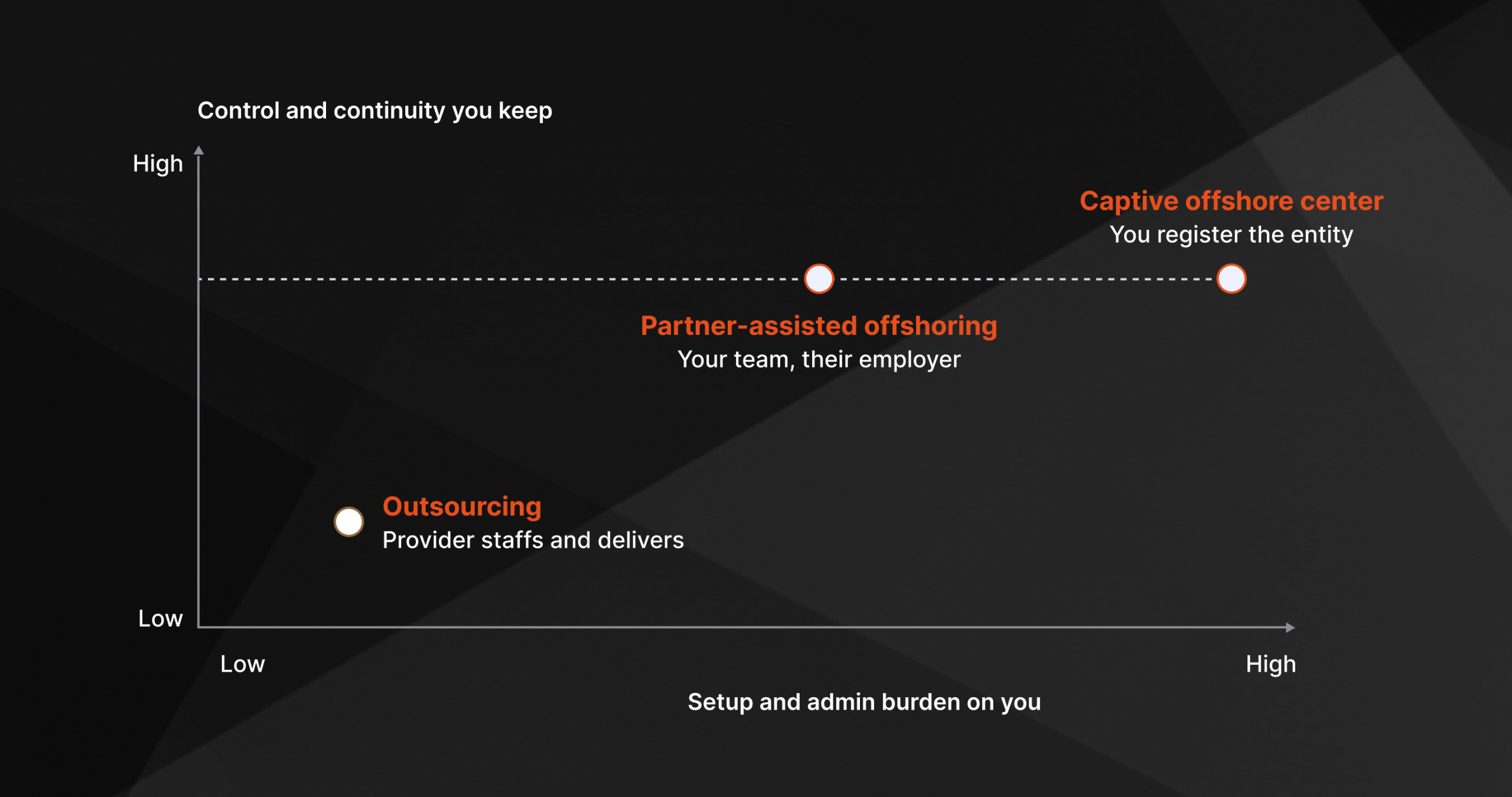
Offshoring means relocating software development to another country, usually for lower costs, a deeper talent pool, or wider time-zone coverage. It comes in two forms. In a captive center, you register your own entity abroad and employ the team directly, which gives you full ownership but is the slowest and most resource-intensive route. In partner-assisted offshoring, a local provider handles employment, payroll, and office setup, while hiring decisions, priorities, and daily management stay with you.
For example, a US company builds a software development team through a vendor in Poland and manages it directly as part of its engineering organization.
For example, a US company builds a software development team through a vendor in Poland and manages it directly as part of its engineering organization.
Deciding whether to offshore vs outsource is a separate question from where the team sits: you can move development abroad and still keep delivery under your own management.
Outsourcing vs offshoring: Key differences
Now that you have a working outsourcing and offshoring definition for each model, let’s compare them directly. Both give you access to software development capacity beyond your local talent pool. Also, see how onshore, nearshore, and offshore outsourcing compare.
So how are outsourcing and offshoring different in practice? Three things: operational control, how deeply the team integrates, and how the money is structured.
| Outsourcing | Offshoring | |
| Definition | Handing work over to a third-party provider | Moving operations or teams to another country |
| Location | Can be domestic or international | Always involves another country |
| Control over team | Usually lower: the provider manages delivery | Usually higher: the company manages the team |
| Cost structure | Project-based, fixed-price, or T&M fees | Salaries plus operating costs abroad |
| Team integration | Team remains with the provider | Team is typically integrated into the company |
| IP ownership | Set out in the contract | Typically retained by the company |
| Best for | Short-term projects, specialist work, fast scaling | Long-term capacity building, R&D, larger teams |
| Setup time | Often a matter of weeks | Can take months for a captive center |
Not sure which side of this table fits your project?
Talk it through with nCube — no commitment, just a scoping call.
The biggest difference between outsourcing and offshoring is who runs the work day-to-day. In an outsourcing setup, the client sets the goals, while the provider staffs the team from their bench and handles delivery. Clients’ leadership spends less time managing individual engineers but loses control over day-to-day execution and who is assigned to the project. This is also the split between staff augmentation vs project outsourcing.
Offshoring gives you room to stay hands-on. You build your own team abroad and your leadership remains closely involved in hiring, priorities, and daily work. That can be a better fit when the offshore team is expected to become a long-term part of your team.
Both models cut costs. The difference is in the billing structure. Outsourcing usually puts a price on a defined piece of work, while offshoring puts a monthly price on engineering capacity. With partner-assisted offshoring, you add engineers at a monthly per-person rate, while the provider handles the employment and local setup behind them.
When developing a product over the long term, keeping the same team is important because replacing engineers can lead to a loss of technical and product knowledge. Offshoring is a good choice if you want your team to learn your codebase and work closely with your internal staff. Outsourcing is better if continuity is less important, and you mainly want to hand off delivery to an outside provider.
Offshoring and outsourcing: Benefits and risks
Benefits of outsourcing
No need to build delivery capacity. Using the provider’s team, tools, and processes to deliver the agreed scope is what many businesses without internal IT teams need. You avoid hiring, onboarding, and maintaining permanent capacity for work that may only be needed for one project or function.
Access to specialist delivery expertise. Outsourcing lets you bring in a provider that already knows how to handle a specific function, such as QA, cloud migration, or mobile development. Instead of building that expertise yourself, you hand over that part of the work to a team that already has the skills and processes in place.
Flexibility around engagement. Outsourcing works well when you need a provider to take on a defined piece of work for a limited period, such as a migration, release, or product launch. Once that scope is delivered, the engagement can end without changing your permanent team.
Benefits of offshoring
Lower long-term development costs. By building a team in a lower-cost market, you can reduce the cost per engineer while maintaining an offshore dedicated development team over time.
A wider talent pool. Offshoring removes the limits of local recruitment. Companies can hire from mature engineering markets where certain skills are easier to find or where competition for senior developers is less intense.
Better team integration. Offshore engineers can work closely with your internal leaders, use your tools, and follow your processes. Over time, they learn more about your product and provide more continuity.
Wider time-zone coverage. Teams in different regions can keep development moving for more hours each day. This works best when there is enough overlap for handoffs, reviews, and decisions, which is why many companies prefer nearshore outsourcing over more distant markets.
Use Case
nCube x Life360: Offshore Development
Curious what offshoring could look like for your team specifically?
Risks to consider
Communication and cultural differences can impact both approaches. Large time zone gaps make it harder for teams to work together online.
Both models also require clear contracts, access controls, and ownership terms to protect security and intellectual property.
In outsourcing, the client is often at the mercy of the provider when it comes to quality, because the provider manages delivery end-to-end. With offshoring, your company may need to deal with employment, tax, and compliance rules in another country.
There is also a trade-off in dependency. With outsourcing, you may become reliant on a single provider for delivery, technical knowledge, and continuity. With offshoring, the dependency shifts to the country where your team is based, including its labor laws, employment rules, and local market conditions. We covered the pros and cons of IT offshoring in more depth separately.
Offshoring vs outsourcing: Real-world examples
These offshoring vs outsourcing examples show how well-known companies have approached cross-border development for decades.
The three below span external delivery abroad, a company-owned R&D center, and direct distributed hiring.
Skype: offshore outsourcing that grew into a captive center. When Skype’s founders needed to build the product, they turned to Estonian engineers they already knew from earlier projects — external delivery in another country. Much of the early software was developed in Tallinn, which later became one of Skype’s own engineering hubs.
Spotify: distributed hiring, which is neither model. As Spotify expanded, it hired across broader talent pools while letting existing staff choose where they worked. Everyone stays a direct Spotify employee — no provider, no relocated unit — which makes it a useful contrast to both models above.
Life360: partner-assisted offshoring. When Life360 needed to expand its R&D in 2020, nCube helped it build a 50+-person development center in Eastern Europe in under 12 months. We handled recruitment, HR, office setup, and ongoing support, while the engineers became closely integrated with Life360’s product organization.
How to choose between outsourcing and offshoring
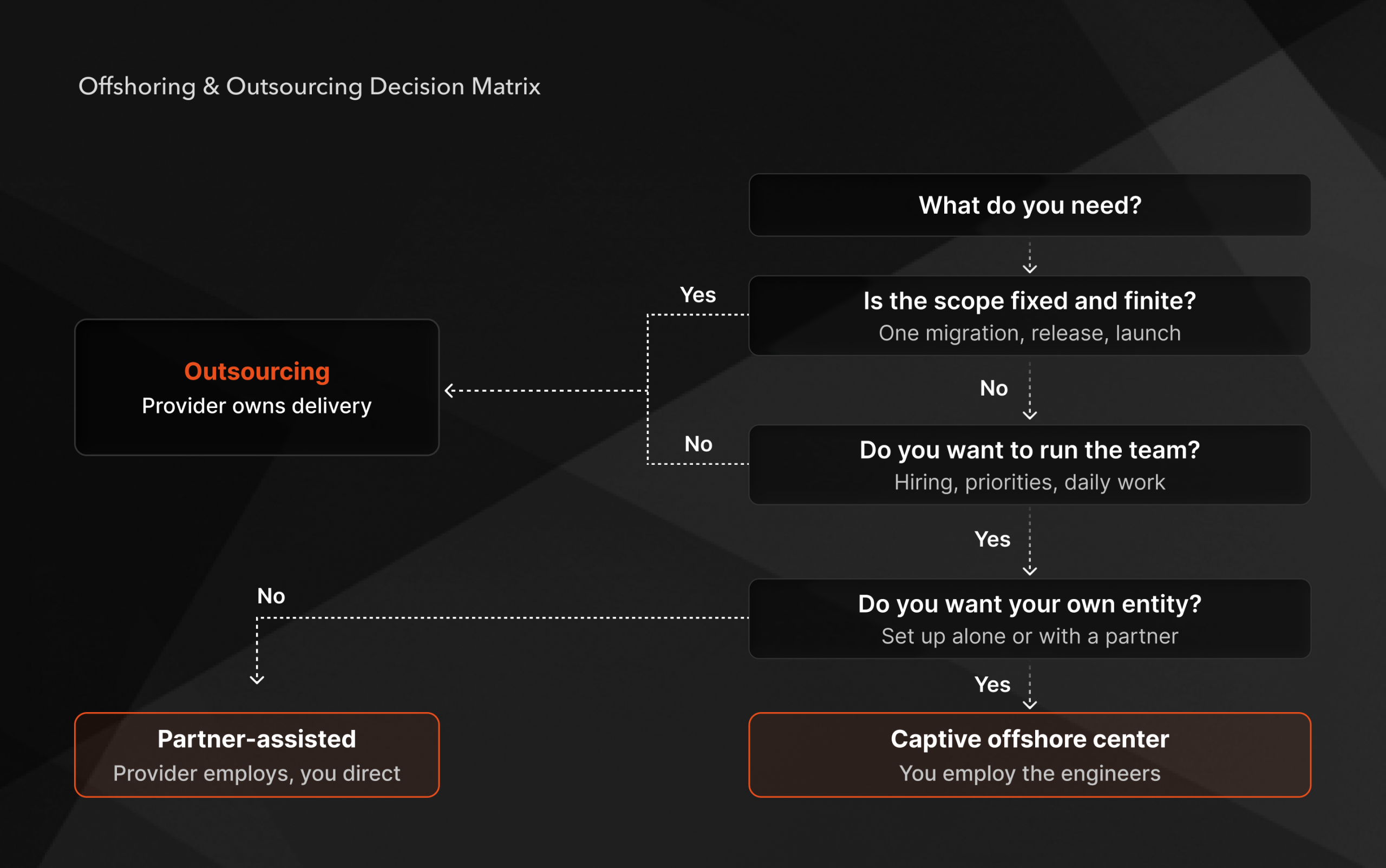
Understanding the outsource vs offshore trade-offs helps here. Besides deciding whether you want to manage engineers and build a long-term unit or hand off a specific outcome to a provider, weigh offshoring versus outsourcing for a specific project against these four factors:
- Project scope and duration. Outsourcing is a good choice for projects that are clearly defined and do not need a permanent team. If your project will last for years, needs ongoing product knowledge, or your team will keep growing, offshoring or a hybrid approach may work better.
- Budget. Comparing outsourcing versus offshoring on budget alone is misleading. Outsourcing lets you pay for a specific scope or the time used. Offshoring is better if you plan to pay for engineering services monthly and want steady per-developer costs.
- Talent needs. If your goal is to build a team rather than just complete a project, offshoring is often the better choice. This approach gives you engineers who can stay with your product, learn the codebase, and become part of your larger engineering team. Outsourcing is a better option when you need to handle a specific task or deliver a certain function, without adding long-term engineering capacity to your team. Where the work is ongoing R&D rather than defined delivery, it’s worth weighing R&D, outsourcing, and staff augmentation side by side before you commit to a model.
- IP and compliance. Closely integrated offshore engineers often give you more direct control over tools, repositories, and access. With outsourcing, the provider may develop and test in its own environment, so control depends heavily on the contract.
If you’re weighing these trade-offs for your own team, nCube can help you apply this framework to your specific scope and budget.
Most companies do not stick to just one model. Instead, many choose a hybrid approach called partner-assisted offshoring. In a setup like this, a provider handles employment, recruitment, and local operations, but the engineers still report to you and work in your sprints. Staff augmentation services and dedicated teams work in a similar way. You get offshoring’s control and continuity without registering a company abroad, and outsourcing’s speed to launch without handing over delivery.
Conclusion
If you’re still deciding between outsourcing vs offshoring: If you want engineers embedded in your product, processes, and day-to-day work for the long term, offshoring gives you that. If the scope is fixed and you want delivery tied to a defined budget, it’s much simpler to outsource.
Many companies use both, managing a stable offshore team for ongoing product work and outsourcing defined, one-off pieces to a provider.
Still weighing the two? nCube can walk through your specific scope and budget with you.
Frequently asked questions on offshoring and outsourcing from tech leaders
What is the difference between offshoring and outsourcing?
Outsourcing is about who does the work: you delegate it to an external provider, anywhere in the world. Offshoring is about where the work happens: you move it to another country, but you can still manage the team yourself.
Can a company use both outsourcing and offshoring at the same time?
Yes. This is called offshore outsourcing, a practical illustration of what offshoring and outsourcing look like when combined. A common example is hiring an offshore partner in Eastern Europe to build a dedicated team that you manage directly, while outsourcing a separate, one-off piece of work to another provider.
Is offshoring cheaper than outsourcing?
Not always. Offshoring usually means a lower monthly cost per engineer, making it a good fit for ongoing projects. Outsourcing can cost less for short-term or specialized work because you do not need to keep a dedicated team. Offshoring is different from outsourcing because you pay for capacity rather than a delivered scope — so the cheaper model depends on how long the work runs, not on the day rate.
What are the risks of outsourcing software development?
The biggest risks usually come down to quality, communication, and control. If the provider owns most of the delivery process, it can be harder to spot issues early, and unclear IP terms or heavy dependence on one vendor can create problems later.
What is offshore outsourcing?
Offshore outsourcing means contracting a provider in another country to do the work. Unlike pure offshoring, delivery stays with the vendor rather than your own leadership — which is why many companies pick it: lower costs without building management capacity abroad. It’s the middle ground in the offshore vs outsourcing decision.
How do I choose between outsourcing and offshoring for my project?
Whether you want a finished result or a team that works closely with your product, that’s the core of the offshoring vs outsourcing decision. Outsourcing works best for specific projects or specialist tasks. Offshoring is better for ongoing development, more control, and long-term needs.
Recommended articles